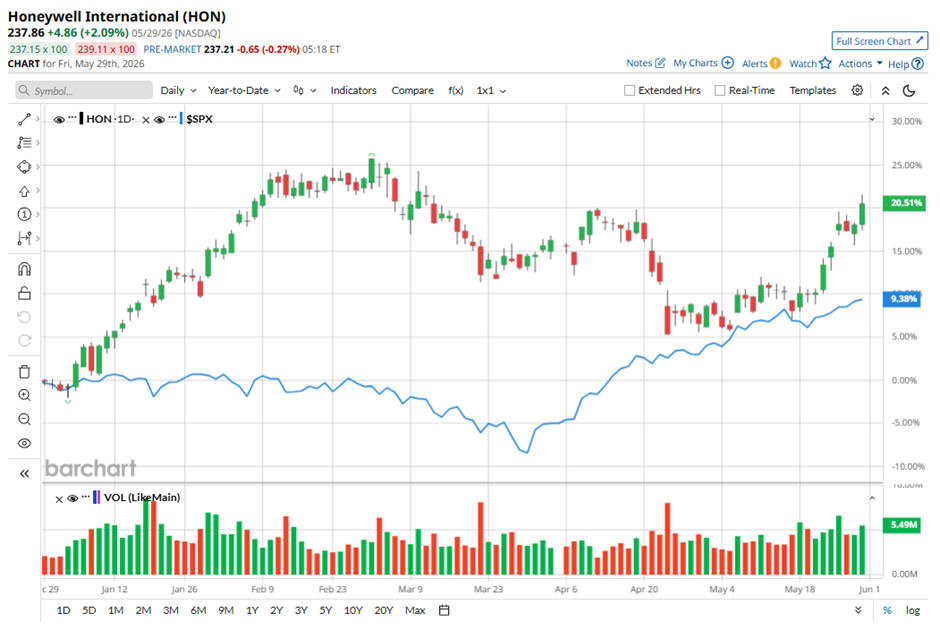
Honeywell is advancing a major restructuring, with its Aerospace spin-off set for June 29 and the Quantinuum IPO planned for this month, while new brand identities were unveiled for the future Honeywell Technologies and Honeywell Aerospace businesses. Q1 fiscal 2026 adjusted EPS beat at $2.45 versus $2.32 expected, and management reaffirmed full-year guidance of $10.35 to $10.65 EPS, $38.8 billion to $39.8 billion in sales, and $5.3 billion to $5.6 billion in free cash flow. Analysts remain constructive, with Barclays lifting its target to $251 and the consensus target at $249.71, implying 6.24% upside.
The market is beginning to price Honeywell less like a diversified industrial and more like a portfolio of separable assets, which is why the stock is being rewarded even before the breakup closes. The key second-order effect is multiple expansion: as the aerospace and automation businesses report under cleaner P&Ls, the market is likely to assign each a tighter peer set and higher sum-of-parts valuation than the current conglomerate discount. That makes the next two investor days more important than the actual spin date for near-term price discovery.
The more interesting setup is that the spin creates forced ownership friction. Index funds and sector mandates will eventually have to choose between a slower-growth, cash-generative automation/software asset and a higher-beta aerospace defense/aftermarket asset, which can widen valuation dispersion over the next 3-6 months. Quantinuum adds another layer: if the IPO prices well, it becomes a proof point that Honeywell can monetize optionality without sacrificing the core industrial franchise, but a weak print would re-open questions about management’s capital allocation credibility.
The main risk is that investors are extrapolating clean separation economics before stranded costs and transition friction are fully visible. The cash flow profile over the next two quarters may look noisier than the earnings trajectory, and any disappointment in the aerospace standalone margin structure could compress the rerating trade quickly. The bigger contrarian point: the stock may already reflect a good deal of the breakup premium, so upside from here likely requires either a surprisingly aggressive capital return framework or Quantinuum pricing above the market’s embedded expectation.
From a trading perspective, the cleanest expression is not a naked long HON but a relative-value basket versus other large-cap industrials that lack a similar catalyst stack. The event-driven path from now into late June favors owning the setup into the two investor days, then reassessing post-disclosure if the implied sum-of-parts has become fully visible. If management undershoots on separation economics, this can retrace quickly because the near-term buyer base is mostly catalyst-driven rather than fundamental long-only conviction.
AI-powered research, real-time alerts, and portfolio analytics for institutional investors.
Request DemoOverall Sentiment
moderately positive
Sentiment Score
0.65
Ticker Sentiment
