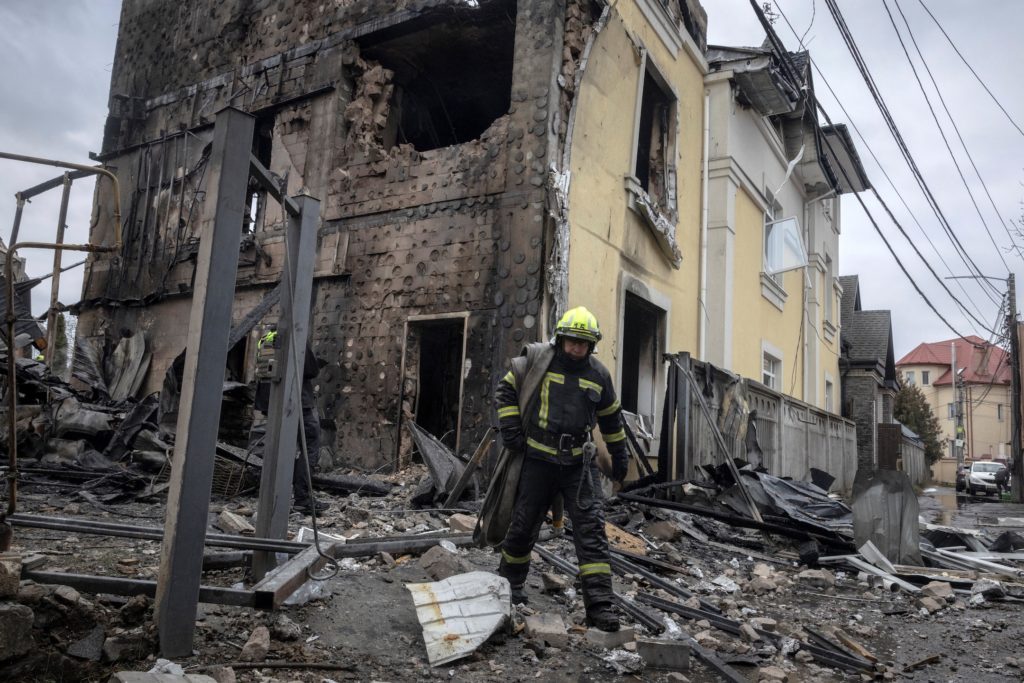
Russian forces launched a barrage of ballistic missiles and drones at Kyiv, striking apartment buildings and energy infrastructure and killing at least one person with nearly 30 injured, an escalation that coincides with a scheduled meeting between President Trump and President Zelenskyy and raises near-term geopolitical risk. A fast-moving winter storm disrupted travel across the Great Lakes and Northeast, canceling more than 1,500 flights, while California dropped its lawsuit over the cancellation of more than $4 billion in federal high-speed rail grants and said it will pursue its own funding, creating fiscal and project execution implications for the San Francisco–Los Angeles rail program.
Market structure: Geopolitical escalation around Ukraine skews winners to defense primes (Lockheed LMT, Northrop NOC, Raytheon RTX), commodity producers (oil, gas) and safe-haven assets (gold, Treasuries). Losers are cyclical travel/airlines (AAL, UAL) and Ukrainian/Eastern European credit; energy supply risk increases pricing power for LNG and pipeline owners over the next 1–12 months. Cross-asset: expect a short-lived USD bid and lower sovereign yields (flight-to-quality), ID short-term VIX spikes; oil/natgas react asymmetrically—European gas spikes more than global crude unless escalation threatens seaborne flows.
Risk assessment: Tail risk includes full-scale escalation or NATO logistics choke points causing oil to spike >$20 (e.g., Brent >$100) within weeks and broad sanctions disrupting supply chains. Time horizons: immediate (0–7 days) volatility around Trump–Zelensky meeting; short-term (1–3 months) order visibility for defense contractors and commodity price resets; long-term (3–24 months) potential sustained Western defense spending if conflict endgame stalls. Hidden dependencies: meeting outcome, US aid appropriations, and winter weather logistics can flip sentiment quickly—track congressional aid votes and oil >$85 as triggers.
Trade implications: Tactical core: size modestly—1–2% portfolio long in LMT/NOC (split) for 3–12 months; 1% GLD as tail hedge; 0.5–1% long TLT to harvest duration if risk-off deepens. Volatility: buy a 1-month VIX 25/40 call spread (small allocation 0.25–0.5%) to capture event spikes around the meeting. Pair trade: long LMT (1%) / short UAL (0.75%) to express defense upside vs travel cyclicality; increase energy exposure (XOM) by +1% only if Brent >$85 for 3 consecutive sessions.
Contrarian angles: Consensus may overpay permanent defense repricing—2014 Crimea showed defense outsized moves then partial mean reversion over 6–12 months, so favor option structures over outright large longs. De-escalation after the meeting would snap VIX and defense names lower—cap risk with 3–6 month protective collars or staged buys (add-on only after 10–15% pullback). Watch California’s decision path: state-funded rail implies selective construction/industrial upside (CAT, AECOM) but also increased CA muni issuance—consider buying CA muni yield + spread >50bps vs Treasuries for carry.
AI-powered research, real-time alerts, and portfolio analytics for institutional investors.
Request DemoOverall Sentiment
moderately negative
Sentiment Score
-0.35
