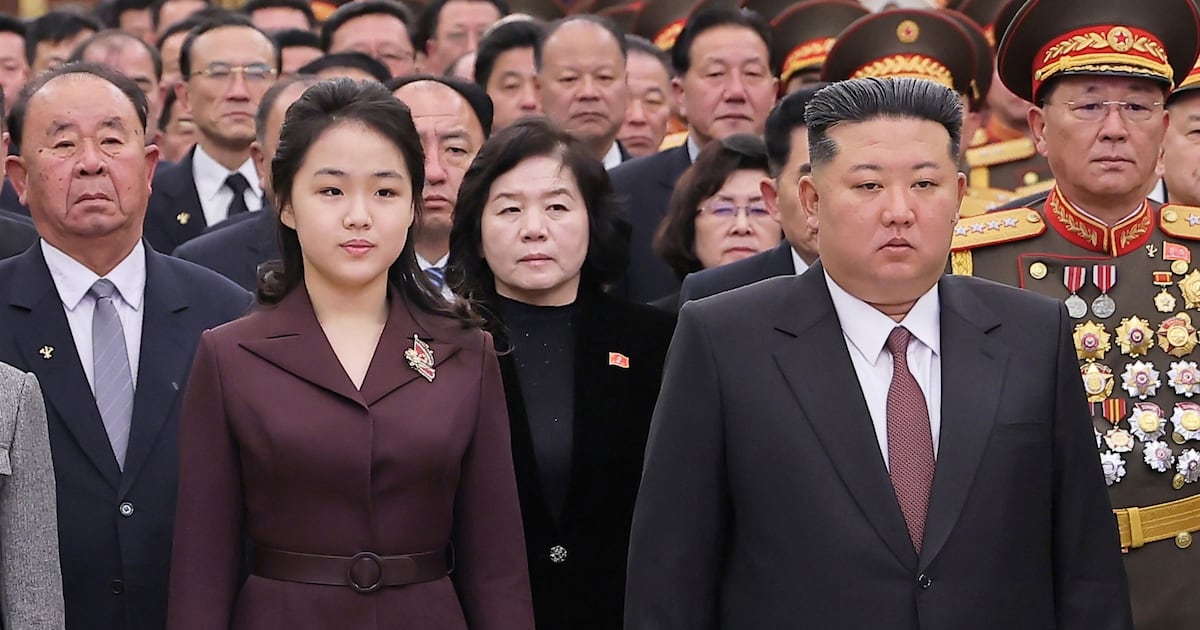
South Korea's National Intelligence Service says Kim Ju-ae has entered the 'designated successor' stage within North Korea's leadership succession process, signaling formalized heir preparation in the Kim dynasty. The development reinforces regime continuity but raises regional geopolitical uncertainty that could sustain a higher risk premium for Korean Peninsula exposures and influence investor positioning in defense and regional risk-sensitive assets. No financial figures were reported, and near-term market impact is likely limited but relevant for macro and geopolitical risk assessments.
Market structure: A declared succession signal from Pyongyang increases regional political risk, benefiting defense primes (RTX, LMT, GD) and aerospace ETF ITA via higher expected defense budgets and contractor order flow; export-oriented South Korean equities (EWY, SSNLF) and KRW are immediate losers on risk-off flows and potential supply-chain disruption to semiconductors. Competitive dynamics: Defense suppliers gain pricing power on accelerated procurement cycles (expect +5–15% RFP volumes over 12 months in worst-case scenarios), while Korean exporters face margin compression from currency weakness and insurance/shipping premia.
Risk assessment: Tail risks include a high-impact provocation (10–25% probability over 12 months) triggering sanctions, maritime disruption, or targeted cyberattacks on fabs; immediate (days) outcome is volatility spikes, short-term (weeks–months) is flight-to-quality, long-term (quarters–years) is potential supply-chain reshoring away from the peninsula. Hidden dependencies: Chinese diplomatic posture, US troop movements, and SK semiconductor fab uptime amplify second-order effects; catalysts to watch are joint US-ROK exercises and NIS intelligence releases in the next 30–90 days.
Trade implications: Tactical trades: buy defense equities/calls and gold/TLT as risk-hedges; short Korea/indexed exporters via EWY or puts if KRW weakens >2% vs USD in 7 days; consider energy exposure (XLE/Brent) if crude breaches $85/bbl. Timing: initiate in the next 1–4 weeks with 3–9 month horizons, trim on 10–25% rallies or if de-escalation signals emerge.
Contrarian angles: Consensus may overprice sustained escalation—if no kinetic events within 60 days, expect mean reversion in EWY/SSNLF (20–30% of initial drawdown recovery) and profit-taking in defense names; defense valuations already reflect part of the risk so use options to avoid overpaying. Unintended consequence: increased ROK defense spending could lift local industrial suppliers (SMID caps) and offset some exporter losses over 12–24 months.
AI-powered research, real-time alerts, and portfolio analytics for institutional investors.
Request DemoOverall Sentiment
mildly negative
Sentiment Score
-0.25
