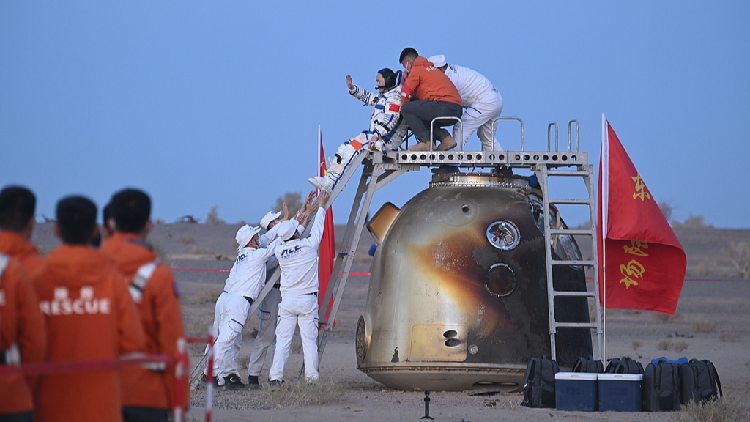
China's Shenzhou-21 astronauts safely returned to Earth at 8:11 p.m. after a 210-day mission, marking a complete success for the emergency crew rotation. The crew set a new Chinese record for the longest single-crew spaceflight and completed three spacewalks plus multiple scientific experiments. The article is primarily a factual update on China's manned space program with limited direct market relevance.
The market read-through is not “space is bullish,” it’s that China has just demonstrated a credible fail-safe for high-value human spaceflight after a debris-related failure mode. That lowers the perceived political and operational cost of keeping the station manned, which should extend procurement visibility for any domestic supplier set tied to crewed launch, rendezvous, docking, life-support, and debris-mitigation hardware. The second-order winner is the industrial base around reliability engineering: redundancy, sensors, thermal protection, robotics, and recovery systems should see a step-up in qualification spending even if headline launch cadence does not change.
The more important implication is competitive signaling. China’s ability to execute an emergency launch and swap return vehicles suggests the program has moved from “symbolic space achievement” to “operational resilience,” which is the threshold that usually unlocks higher-budget follow-on missions and more frequent station utilization. That creates a longer runway for domestic avionics, advanced materials, and specialty electronics suppliers than for pure launch names, because the bottleneck shifts from getting to orbit to surviving and servicing in orbit.
Near-term, the catalyst is policy: expect rhetoric around self-reliance, civil-military integration, and space debris defense to intensify over the next 1-3 months. The tail risk is reputational, not technical: if a future debris incident forces another emergency response, it would reinforce the need for hardening spending; if no incidents occur, the headline impulse fades and these names can mean-revert. Over 12-24 months, the more durable trade is in the picks-and-shovels of station lifecycle support rather than launch excitement.
Contrarian view: the consensus may overestimate direct revenue leverage from the mission itself. This is likely a validation event, not a one-off procurement shock, so the trade is not to chase a broad aerospace basket after the headline. The underappreciated angle is that every successful contingency procedure raises the value of domestic suppliers with proven QA, traceability, and systems integration — exactly the vendors that usually trade at a discount because they are less glamorous than launch providers.
AI-powered research, real-time alerts, and portfolio analytics for institutional investors.
Request DemoOverall Sentiment
mildly positive
Sentiment Score
0.15
