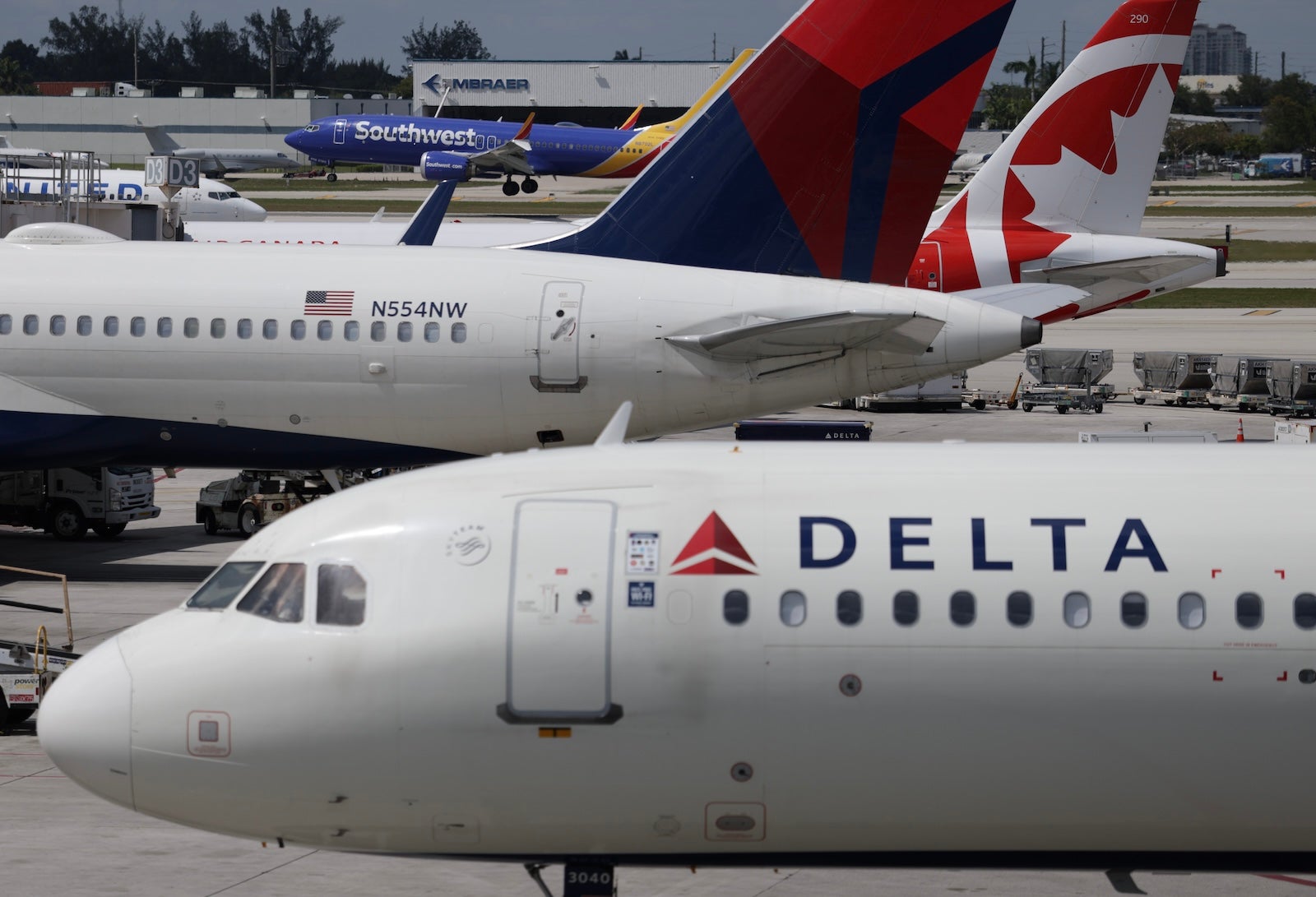
Average jet fuel prices jumped nearly 73% to $4.17 per gallon by April 21 after Strait of Hormuz access was largely closed, forcing airlines to cut capacity and suspend routes. Delta, Air Canada, Edelweiss Air and Norse Atlantic all announced reductions, including multiple U.S. and transatlantic route suspensions, to protect margins as fuel costs make lower-profit flights uneconomic. The news is a clear negative for airline earnings and suggests further pressure on fares, capacity and route networks if fuel prices remain elevated.
This is less a demand shock than a margin-squeeze event that forces capacity rationing. The key second-order effect is that carriers with the least pricing power and the worst fuel hedging/programmed exposure will be the first to trim marginal flying, which can temporarily improve industry RASM by removing weak routes while simultaneously suppressing systemwide ASM growth. That creates a bifurcation: premium, fortress-network airlines can defend yield better than long-haul leisure or transatlantic niche operators, but the market may still over-penalize all airlines as if the hit were uniform.
The most important timing issue is that the earnings damage is front-loaded over the next 1-2 quarters, while the route cuts can extend well into 2026-27, meaning management teams are effectively choosing near-term revenue preservation over longer-dated network share. That is usually constructive for incumbents with hub dominance because stranded demand often reappears on competing carriers’ hubs rather than disappearing outright. The losers are likely to be smaller international challengers and marginal transatlantic capacity providers, where fuel is a larger share of trip economics and cancellation risk can permanently weaken brand trust.
Consensus may be underestimating the elasticity of ancillary costs beyond jet fuel. Higher fuel can force lower utilization, which raises unit costs in maintenance, labor, and aircraft ownership per available seat mile; that compounds the headline fuel shock. At the same time, lower off-peak flying should ease airport congestion and could slightly improve operational reliability, which helps large network carriers relative to point-to-point operators. If crude/jet fuel retraces quickly, the market will likely snap back faster than route networks can be rebuilt, creating a short-lived but tradable dislocation.
AI-powered research, real-time alerts, and portfolio analytics for institutional investors.
Request TrialOverall Sentiment
strongly negative
Sentiment Score
-0.55
Ticker Sentiment
