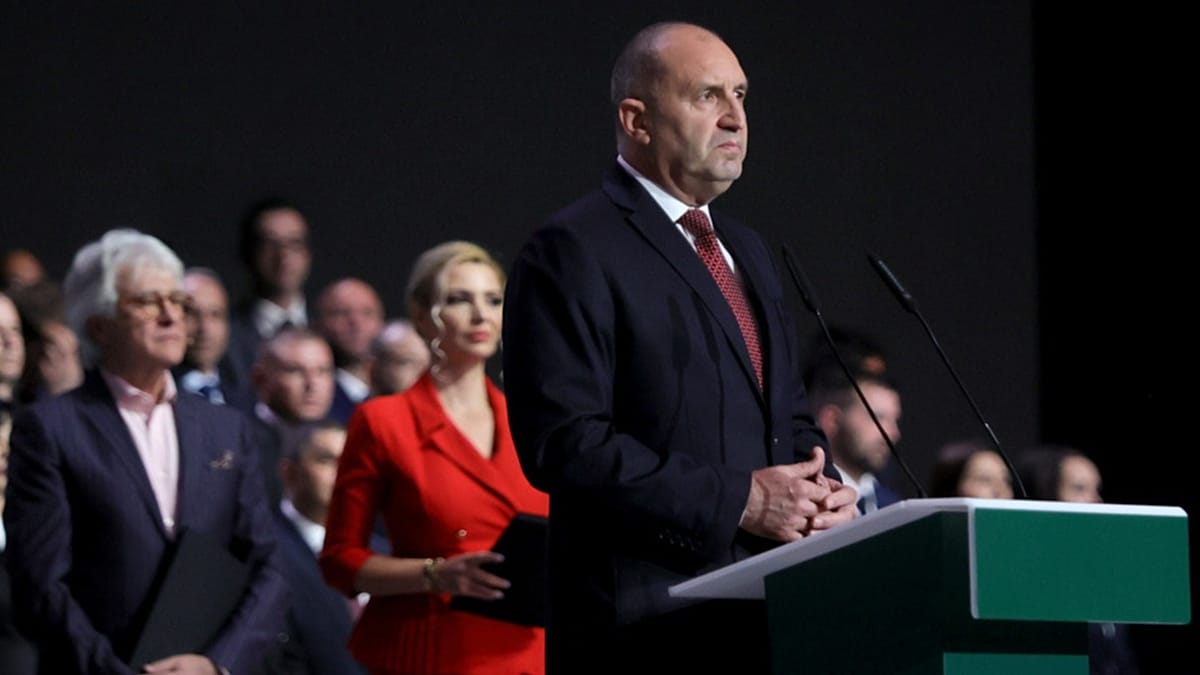
Rumen Radev won Bulgaria’s first outright parliamentary majority since 1997 and was named prime minister, setting up a potentially more stable government after years of political churn. His agenda centers on anti-corruption reforms, a 2026 budget, inflation control, and judicial reform, with nearly €400 million in EU funds contingent on progress. The appointment is constructive for governance but remains a domestic political development with limited direct market impact.
The immediate market read is less about ideology than cash flow: a more durable government increases the probability that EU money starts flowing, which matters because Bulgaria’s fiscal and external buffers are thin. The first-order winners are domestic banks, construction, utilities, and any listed proxy for local consumption because reduced political churn lowers funding risk and improves visibility on public investment timing. The second-order loser is the anti-corruption trade itself if reforms stall; that would keep the country in a low-multiple, high-risk-premium regime despite headline political stability.
The bigger setup is duration, not day-one headlines. If the new cabinet can credibly unlock the blocked EU tranche over the next 1-2 quarters, local rates and sovereign spreads could compress enough to re-rate domestic financials and any EUR-linked liability names. If not, inflation plus budget pressure creates a nasty mix: the government is forced into either tighter fiscal policy or quasi-populist spending, both of which would undermine the stability premium and push the market back into the old “permanent crisis” discount.
The contrarian risk is that the anti-corruption mandate is harder to monetize than the market assumes. Corruption cleanup tends to hurt incumbents and procurement-heavy sectors before it helps anyone; the near-term trade may therefore be negative for politically connected contractors and positive only for firms with cleaner governance and lower sovereign beta. Russia/EU hedging also matters: a softer stance toward Moscow could create periodic friction with Brussels, making EU disbursement a binary catalyst rather than a smooth flow.
From a trading lens, this is a selective-risk regime, not a broad EM beta call. The best expression is to own the beneficiaries of lower policy uncertainty while fading names most exposed to discretionary state spending and public tenders. The setup likely plays out over months, with the key catalyst window being the next budget cycle and any EU funding decision; if those slip, the move retraces quickly.
AI-powered research, real-time alerts, and portfolio analytics for institutional investors.
Request DemoOverall Sentiment
neutral
Sentiment Score
0.10
