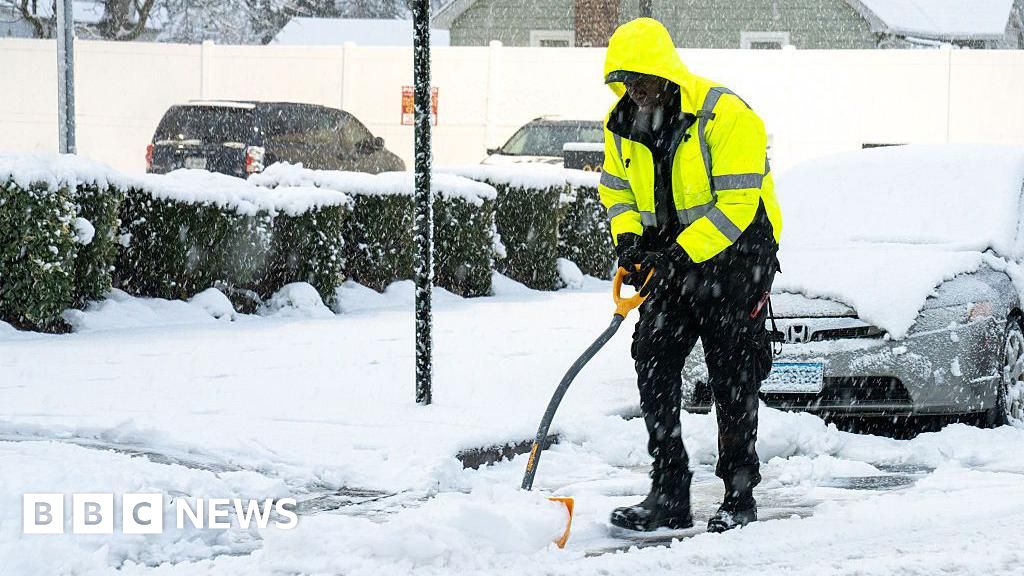
A major winter storm forecast for the U.S. Northeast disrupted peak holiday travel with roughly 1,500 flights cancelled and 5,400 delayed nationwide; New York-area airports (JFK, Newark, LaGuardia) are hardest hit. Major carriers reported significant operational impacts today (JetBlue 227 cancellations, Delta 213, Republic 157, Southwest 146, and ~100 each for American and United), with up to 9 inches of snow expected and the heaviest falls between 18:00 and midnight. The immediate implications are elevated short-term operational costs, potential revenue disruption and rebooking liabilities for airlines, and localized transportation risk, though the event is unlikely to cause sustained market dislocations.
Market structure: Acute winners are ground-transport providers, car-rental/parking operators and travel-insurance underwriters who see immediate demand; direct losers are short‑haul/high‑frequency carriers (JBLU, to a lesser extent DAL) due to knock‑on crew and aircraft misalignments that raise per‑flight costs by 10–30% for affected segments over the holiday window. Competitive dynamics favor carriers and airports with deeper reserve crews, de‑icing assets and NYC hub scale — legacy carriers can reassign flows more cheaply, widening short‑term relative margins vs ultra-low-cost operators. Cross‑asset: expect a small widening in airline credit spreads (20–50bp on weaker issuers), a 15–40% spike in near‑term single‑stock IV for affected airlines, negligible FX move, and minimal persistent impact on oil products absent prolonged closures.
Risk assessment: Tail risks include prolonged airport closures (multi‑day) that convert holiday revenue into permanent demand loss, regulatory push for higher passenger compensation, or system‑wide IT/crew failures that cascade; probability low (<5%) but impact high (earnings hit >10% for vulnerable carriers). Immediate effects play out in 0–7 days (cancellations/rebooking costs), medium term 2–8 weeks (revenue catch‑up and margin hit), long term quarters are largely recovery unless regulatory change occurs. Hidden dependencies: holiday yield per seat is ~20–40% higher than average so cancellations are disproportionately costly; catalysts that reverse trend include warmer weather or capacity re‑injections by competitors.
Trade implications: Tactical short exposure to JetBlue (JBLU) via limited-duration downside structures is preferable to outright shorting; favor pair trades long DAL vs short JBLU to capture operational resilience. Use 30–45 day options to buy protection (put spreads) or volatility (straddles) around the next 10–21 days when IV is elevated; rotate proceeds into airport REITs and ground‑transport equities for 4–8 week recovery plays. Entry: implement options within 48 hours while IV is rich; exit 7–21 days after storm abates or on IV collapse >30%.
AI-powered research, real-time alerts, and portfolio analytics for institutional investors.
Request DemoOverall Sentiment
mildly negative
Sentiment Score
-0.25
Ticker Sentiment
Contrarian angles: The market may overshoot downside because most cancellations are rebooked — historical parallels (major US storms 2018–2019) show full revenue recovery within 4–8 weeks; an overreaction could create a buying opportunity in well‑capitalized carriers. Conversely, regulators could seize the moment to tighten passenger protections, creating a structural cost increase; that scenario would make short positions in lower‑liquidity carriers valuable. Unintended consequences include airlines increasing buffer capacity and crew costs post‑season, permanently compressing margins by several percentage points.
