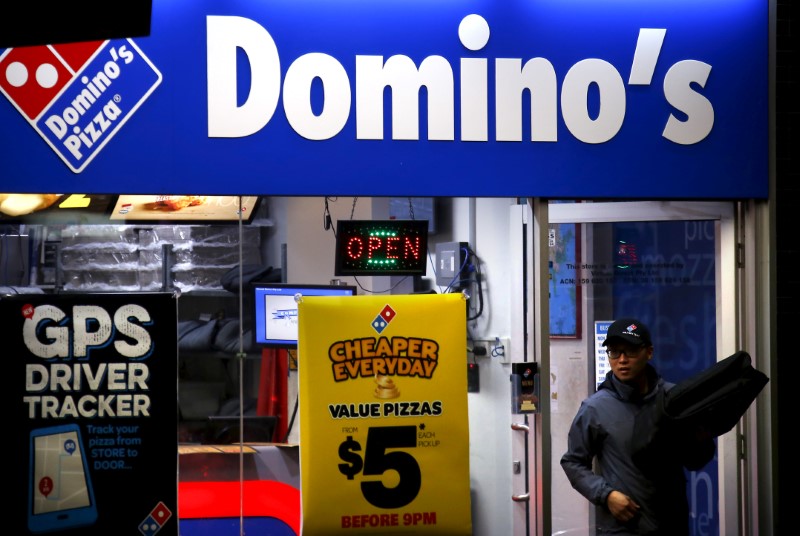
Domino’s Pizza Enterprises fell over 12% to A$15.57 after the U.S. brand owner reported weaker-than-expected Q1 profit and same-store sales, with CEO Russel Weiner citing sluggish international sales. The commentary specifically pointed to underperformance in Australia, New Zealand, Japan, and broader Asia-Pacific markets, where DMP is the largest global franchisee. The weak first quarter raises the risk of a soft annual earnings print due in late July/August.
The key signal is not a one-off franchise hiccup; it’s that the weakest operator in the system is now dragging the master brand’s credibility into multiple geographies at once. That creates a classic negative feedback loop: lower store traffic reduces franchisee economics, which constrains remodels, advertising support, and unit growth, ultimately pressuring the brand’s royalty stream and same-store-sales algorithm for 2-3 reporting cycles, not just one quarter.
The second-order issue is valuation compression at the global franchisor level. Even if the U.S. core stabilizes, investors will likely apply a higher discount rate to international royalty quality because the marginal growth bucket is now the most fragile one; that matters for DPZ because the market typically pays up for predictable, capital-light growth. If the coming print confirms international deceleration, expect multiple pressure first, then estimate cuts later—usually the worst sequence for the stock.
There is a contrarian setup here: the selloff may be overdone if management can isolate the weakness as geography-specific rather than brand-wide. The catalyst path is short: the next earnings call and any commentary on franchisee incentives, closures, or refranchising will determine whether this becomes a transient APAC issue or a broader system reset. A meaningful rebound likely requires evidence of same-store-sales inflection, not just cost actions, because the market will fade financial engineering until traffic turns.
The main downside risk is that this is an early indicator of consumer trade-down and menu fatigue across the broader quick-service sector; if so, peers with similar premium pricing or weak value positioning can de-rate together over the next 1-2 quarters. On the flip side, if Domino’s competitor promotions are the true culprit, then share loss should be temporary and more visible in traffic data than in margins. That distinction matters because the former supports a prolonged short, while the latter becomes a tactical event-driven trade.
AI-powered research, real-time alerts, and portfolio analytics for institutional investors.
Request DemoOverall Sentiment
strongly negative
Sentiment Score
-0.62
Ticker Sentiment
