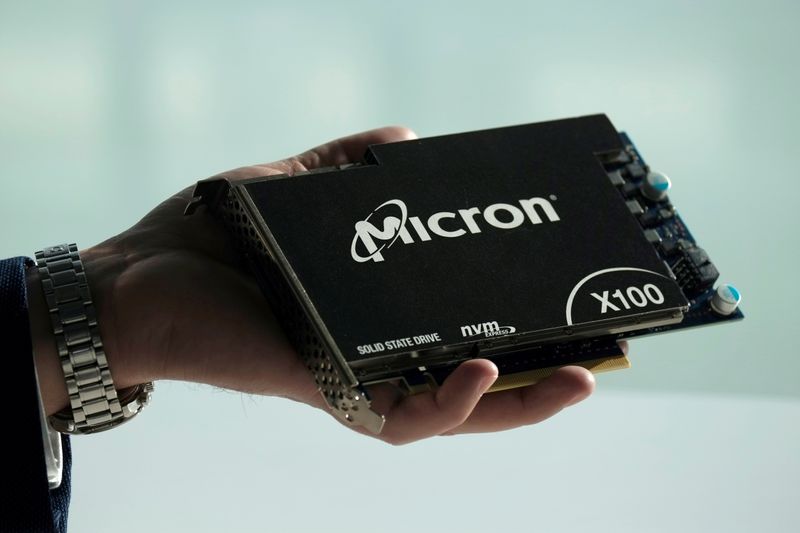
Barclays raised its Micron price target to $1,175 from $675 while keeping an Overweight rating, citing the company’s shift to multi-year Strategic Customer Agreements and expectations for more disclosure on contract structure and potential prepayments. The article also highlights additional bullish analyst actions, including UBS at $1,625 and Mizuho at $800, alongside AI-driven demand and Micron’s move to $1 trillion market value. The news is constructive for sentiment but is mainly analyst-driven and likely to have a limited near-term market-wide impact.
The key signal is not the higher price target; it is the shift from transactional memory sales to contractually embedded supply allocation. That changes Micron from a spot-exposed cyclical into a quasi-capacity allocator, which should compress downside volatility in the next downcycle and support a higher long-duration multiple. The market will likely re-rate this only if investors believe those agreements come with enforceable volumes, prepayments, and visibility into customer commitments; absent that, the move risks being interpreted as narrative rather than cash-flow durability. Second-order, the strategic contract structure can pull forward competitors’ bargaining power in subtle ways. If Micron starts disclosing customer-linked prepayments or multi-year committed volumes, buyers across the memory stack may demand similar treatment from other suppliers, which could temporarily tighten industry supply discipline but also expose weaker operators to price pressure if they cannot secure comparable lock-in. SNDK is the obvious read-through beneficiary on transparency and contracting sophistication, while smaller memory players with less scale are most vulnerable to a world where customers increasingly pay for certainty rather than optionality. The main risk is that consensus is extrapolating an AI-led memory supercycle into a multi-year straight line while underestimating the cadence of supply response. A meaningful portion of the upside thesis depends on execution over the next 2-4 quarters: if DRAM/NAND pricing stabilizes but does not accelerate, the equity can de-rate quickly from a perfect-cycle multiple to a merely good-cycle one. The contrarian view is that the market may be overpricing visibility before Micron has actually converted it into hard backlog quality and FCF conversion. For trading, this is still a better relative-value than absolute-long setup: the best expression is long MU vs short a basket of semiconductor equipment or memory-adjacent laggards that benefit from capex but lack contract visibility. If the company confirms prepayments or stronger customer commitments in the next 1-2 quarters, upside to the stock should come from multiple expansion rather than just earnings revisions. If disclosures disappoint, the stock is vulnerable to a sharp air-pocket because expectations are now anchored to institutionalize the cycle, not merely extend it.
AI-powered research, real-time alerts, and portfolio analytics for institutional investors.
Request DemoOverall Sentiment
mildly positive
Sentiment Score
0.45
Ticker Sentiment
