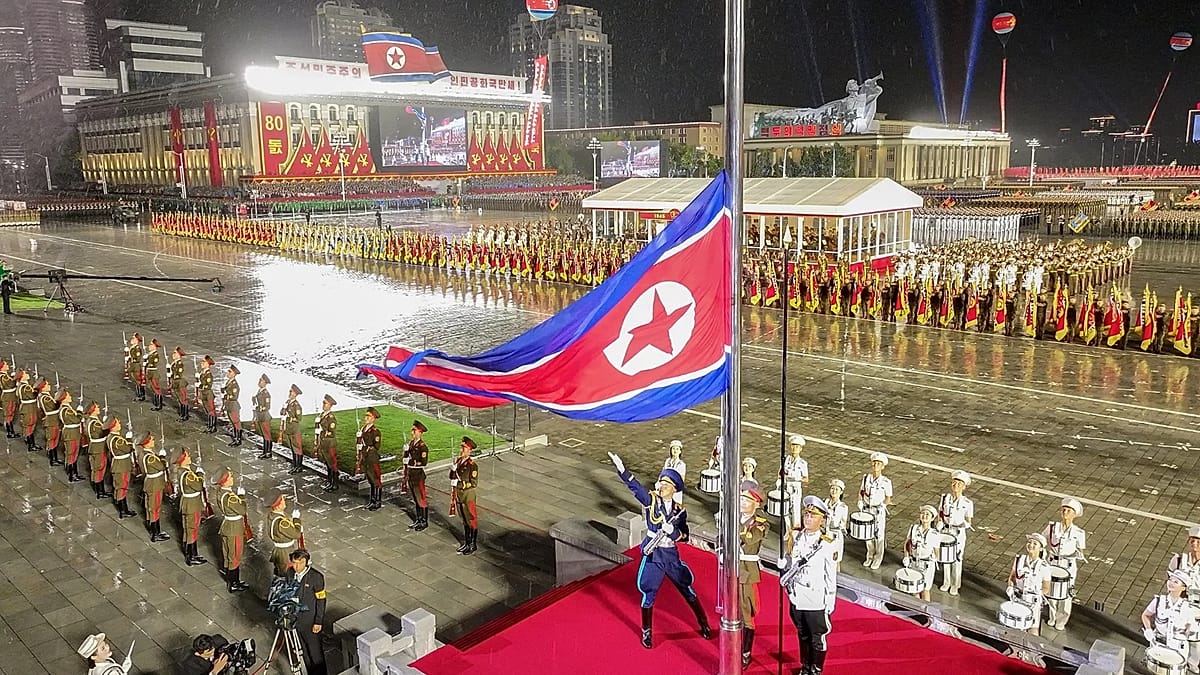
North Korea removed all references to reunification with South Korea from its constitution and added language asserting its northern and southern territorial claims, signaling a more hostile posture toward Seoul. The article also highlights continued military escalation, including four missile tests in April, Kim Jong Un's vow to expand nuclear forces, and North Korea's 2024 defense treaty and troop deployment support for Russia. The shift raises geopolitical risk on the Korean peninsula and reinforces tighter North Korea-Russia-China alignment.
This is less a symbolic legal tweak than a signal that Pyongyang is formalizing a war-economy posture with China as the logistical rear and Russia as the security backstop. That combination raises the probability of sustained missile activity and military-industrial throughput, which matters for regional risk premia because the marginal escalation now looks more durable than episodic. In practice, the market should treat this as a multi-quarter elevation in headline risk rather than a one-off provocation.
The second-order effect is on Korea-linked capital allocation: persistent tension tends to tax inbound capital, cap multiple expansion for domestic cyclicals, and support defense spending across the region. Beneficiaries are the obvious prime contractors, but the less obvious winners are surveillance, missile defense, and munition supply chains that can absorb replenishment demand over 6-18 months. The hidden loser is any Korea-sensitive industrial/export complex that relies on stable cross-border shipping, because even without direct sanctions, insurance, routing, and inventory buffers become structurally more expensive.
The biggest tail risk is not a near-term invasion; it is a steady drift toward formalized bloc alignment that normalizes intermittent tests, cyber activity, and gray-zone incidents. That path can stay benign for risk assets for weeks, then reprice quickly if a test coincides with U.S.-ROK exercises or a Russian transfer of more advanced military know-how. A meaningful de-escalation would require visible inter-Korean engagement plus Chinese pressure on cadence of provocations, which currently looks unlikely.
Consensus is likely underestimating how much Russia’s support changes North Korea’s restraint function. The regime is no longer as dependent on Chinese economic tolerance alone, so it can afford a more confrontational line without immediate macro pain. That reduces the odds that sanctions rhetoric alone will deter behavior, making this a bad environment for fading the geopolitical premium too early.
AI-powered research, real-time alerts, and portfolio analytics for institutional investors.
Request DemoOverall Sentiment
moderately negative
Sentiment Score
-0.45
Ticker Sentiment
