
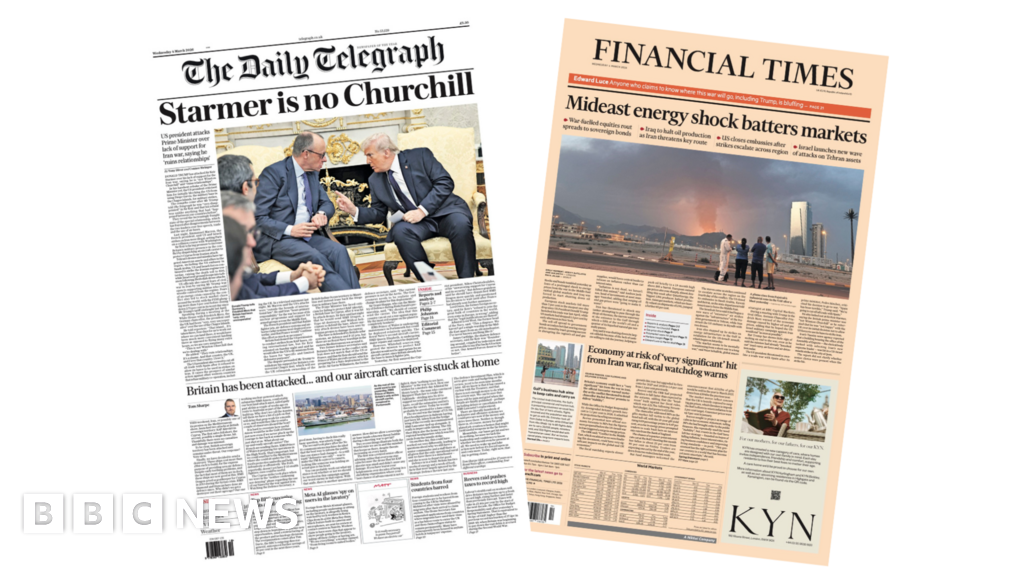
Escalation after US and Israeli strikes on Iran has rattled markets—European equities fell roughly 3% as reports surfaced of Iraqi oilfield closures and threats to tankers in the Strait of Hormuz—prompting strategists to say markets are mentally shifting from a short war to a potential long conflict. The shock is driving energy and fuel-price risk, triggering naval deployments (HMS Dragon to Cyprus, French fleet moves) and adding diplomatic friction between the US and UK after President Trump publicly attacked Prime Minister Starmer, all of which raise geopolitical risk premia and support a defensive, risk-off positioning for portfolios.
Market structure: Immediate winners are hydrocarbon producers (US majors XOM/CVX, Canadian/Scandinavian producers, XLE/XOP ETFs) and defense contractors (RTX, BA) while European cyclicals (airlines IAG.L, tourism, travel insurers) and UK domestic-sensitive equities are losers; Europe equities already fell ~3% and oil-risk premia are rising, implying +$10–30/bbl move is plausible in weeks. Competitive dynamics favor large integrated producers and LNG exporters with spare capacity and logistics control; smaller refiners/shippers face margin compression and insurance cost passthrough. Cross-asset: expect risk-off flows into USTs and bunds (yields down 10–40bps intraday), USD strength, gold up, and implied equity volatility (VIX) to spike 30–100% depending on escalation.
Risk assessment: Tail scenarios include Strait of Hormuz disruption (10–20% probability) driving Brent to $120–150 within 1–3 months, or NATO entanglement materially widening sanctions and freezing assets; cyberattacks on terminals are medium-tail events. Immediate (days) is liquidity and volatility shock; short-term (weeks–months) is commodity-led inflation and sector rotations; long-term (quarters–years) is accelerated energy security capex and defense spending that re-rates cashflows. Hidden dependencies: marine insurance, re-routing fuel costs, and sovereign FX stress in importers (India/Turkey) that can cascade into credit spreads.
Trade implications: Tactical: establish 2–3% long in XLE or XOP for a 3-month horizon to capture energy upside if Brent breaches $95; buy a 3-month Brent call spread (e.g., long $90 short $140) sized 0.5–1% portfolio as directional asymmetric play. Defensive: allocate 1–2% to RTX/BA (6–12 months) paired with a 1–2% short in IAG.L or STOXX Travel & Leisure ETF to hedge demand risk. Hedging: purchase 1% notional VIX call package or 3-month VXX calls and 1–2% GLD as inflation/flight-to-safety protection.
Contrarian angles: Markets may overprice permanence of disruption—historical Gulf shocks often revert within 6–9 months, creating mean-reversion opportunities in beaten-down European cyclicals and small-cap exporters; consider buying screens of high-quality European utilities and commodity miners on >15% pullbacks. MRU.TO shows neutral sentiment — do not initiate new exposure until 30–60 days of operational clarity or a >10% price dislocation tied to supply contracts; if sanctions fragment supply chains long-term, smaller resource names could rerate higher.
AI-powered research, real-time alerts, and portfolio analytics for institutional investors.
Request TrialOverall Sentiment
strongly negative
Sentiment Score
-0.60
Ticker Sentiment
