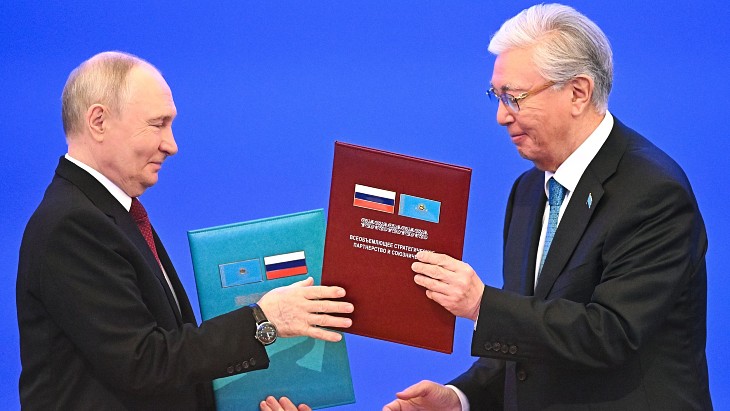
Russia and Kazakhstan signed agreements to build Kazakhstan’s first nuclear power plant, including an export loan and a framework covering construction, maintenance, and fuel supply. Rosatom says the project will use two Russian-designed VVER-1200 units, with preliminary cost estimates of about USD14.4 billion plus USD2 billion for security and infrastructure. Construction is targeted to start in 2027, with the first unit expected online in 2034, supporting Kazakhstan’s long-term energy diversification and low-carbon goals.
This is less a single project announcement than a multi-decade industrial policy lock-in that improves visibility for Russian civil nuclear exports and reinforces Kazakhstan’s role as a strategic swing producer in the nuclear fuel chain. The immediate economic winner is not just Rosatom’s EPC pipeline; it is the broader Russian nuclear ecosystem, which gains long-dated service, fuel, training, and maintenance revenue that tends to be stickier and higher-margin than construction alone. For Kazakhstan, the project converts uranium endowment into a downstream energy-security narrative, potentially supporting domestic power pricing stability and reducing exposure to thermal fuel volatility over time.
The second-order impact is on regional competition for nuclear vendor share. A Rosatom-led first plant materially raises the switching cost for any future reactor fleet standardization, even if Kazakhstan still proceeds with a second Chinese-built unit. That creates a de facto technology bifurcation risk: once one vendor controls the reference plant, training, regulation, spare parts, and fuel logistics usually bias future awards toward the incumbent, especially in an emerging market where execution certainty matters more than geopolitical diversification.
The market’s near-term mistake would be to overtrade this as a uranium price catalyst. New nuclear capacity is a 5-10 year demand story, not a quarter-by-quarter uranium squeeze, and the bigger near-term effect is sentiment support for nuclear supply chain equities, grid buildout, and long-duration infrastructure financing. The real fragility sits in execution: cost inflation, permitting, safety scrutiny, and financing stress could easily push first power beyond 2034, which would defer any fuel-demand benefit and reopen political debate if local inflation or tariff burdens rise.
Contrarianly, the most important missing piece is the financing structure. A favorable sovereign export loan can be economically rational for Kazakhstan but can also mask balance-sheet and FX risk if project costs drift; that often produces political backlash before construction reaches meaningful completion. If Russia uses this as a template for other “export + fuel + training” bundles, the trade is less about one plant and more about a renewed Russian vendor moat in frontier markets, which is bullish for order flow but not necessarily for near-term equity multiples in the broader uranium complex.
AI-powered research, real-time alerts, and portfolio analytics for institutional investors.
Request TrialOverall Sentiment
mildly positive
Sentiment Score
0.34
