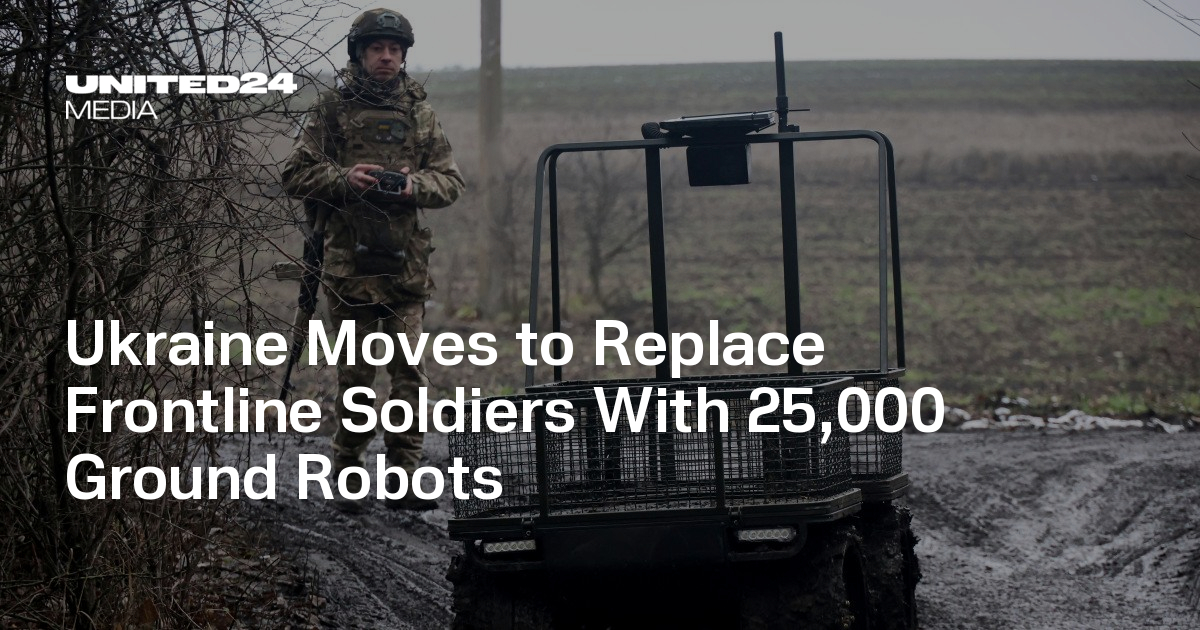
Ukraine’s Defense Ministry plans to contract 25,000 ground robotic systems in H1 2026, doubling the total procured in all of 2025, and aims to have 100% of frontline logistics handled by robots. The ministry said it has already signed 19 contracts worth 11 billion UAH, while March alone saw more than 9,000 logistics and evacuation missions conducted by ground robots. The push underscores rapid scaling in Ukraine’s defense-tech ecosystem, with more than 280 companies and 550 active solutions now in the sector.
This is less a one-off procurement headline than a signal that battlefield robotics is moving from pilot phase to industrialized demand. The second-order beneficiary is not just domestic drone assemblers, but any supplier of ruggedized components, sensors, comms, autonomy software, power systems, and field repair services that can meet wartime reliability standards. The biggest strategic shift is that logistics becomes partially capitalized: each additional robot suppresses demand for human transport, armored vehicle exposure, and evacuations, which should compress casualty-driven operational disruption over time and raise the value of makers with low unit-cost, high-uptime platforms.
The clearest competitive dynamic is that scale will matter more than specs. Longer-dated procurement and contract adjustments should reduce manufacturer working-capital strain, which favors incumbents with production depth and test-proven systems, while smaller shops without balance-sheet capacity may be forced into consolidation or become subcontractors. A less obvious winner is the counter-UAS / EW ecosystem: as robotic ground systems proliferate, the marginal advantage shifts toward companies that can harden autonomy against jamming, spoofing, and thermal detection rather than toward pure hardware vendors.
The main risk is not technology failure, but adaptation by the adversary and procurement bottlenecks. If Russia increases EW density, mines approaches more aggressively, or starts systematically hunting robot logistics corridors, the operational ROI can deteriorate within weeks even if headline deliveries continue. Over months, the bigger constraint is manufacturing throughput: if the state fails to sustain financing and standardized specs, the sector can fragment into custom builds that cannot be scaled cheaply enough to matter at the front.
Consensus may be underestimating how this changes cost curves outside Ukraine. Defense ministries in NATO and Israel will likely use Ukraine’s deployment data to justify their own ground-robot budgets, so the real trade is on future export demand and dual-use autonomy stacks rather than on the immediate war budget. If the first large-scale deployments continue to produce asymmetric tactical gains, the market may be too early in pricing a multi-year capex cycle for unmanned logistics and demining systems.
AI-powered research, real-time alerts, and portfolio analytics for institutional investors.
Request DemoOverall Sentiment
mildly positive
Sentiment Score
0.35
