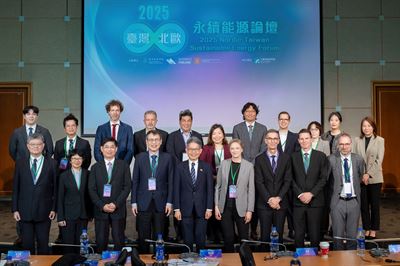
Minesto has been awarded a €24,000 grant from the Swedish Energy Agency under the Global Innovation Accelerator to accelerate market development in Taiwan and participated in the 2025 Nordic-Taiwan Sustainable Energy Forum in Taipei. The company is targeting project finance and partnerships to build tidal energy plants near Keelung and Green Island, leveraging collaborations with National Taiwan Ocean University and Taiwan Cement Green Energy and deploying its patented low-flow tidal technology. The funding and stakeholder engagement advance Minesto’s commercialisation efforts in Taiwan but represent an early-stage, strategic development rather than material near-term financial impact.
Market structure: The SEA €24k grant is symbolic but signals policy tailwinds for niche marine energy; direct beneficiaries are Minesto (MINEST) and Taiwanese partners (National Taiwan Ocean Univ., Taiwan Cement Green Energy) and specialist subsea suppliers (e.g., Prysmian PRY.MI). Near-term market share shifts are minimal—tidal remains <1% of renewables capacity—but pricing power for predictable baseload marine power could command 5–15% PPA premium in island grids like Taiwan over volatile solar/wind. Supply demand is supply-constrained: few proven tidal vendors imply multi-year lead times and bottlenecks in bespoke anchors, turbines and dynamic cables.
Risk assessment: The grant reduces market-entry friction but is immaterial financially; tail risks include technological failure/loss at sea (single-event project write-offs of €10–100m), Taiwanese regulatory delays (12–24 months), and capital scarcity for first-of-kind farms leading to >30% dilution for early equity holders. Immediate (days) impact is negligible; short-term (3–12 months) is partnership and LOI formation; long-term (2–7 years) is project delivery and cashflows. Hidden dependencies: insurance pricing, seabed leases and local fisheries opposition can double lead times and capex.
Trade implications: For speculative exposure, MINEST is the direct play—allocate small thematic weight (1–3% of liquid equities) while hedging execution risk. Industrial suppliers (Prysmian PRY.MI, Siemens Energy SIE.DE) gain from cable/turbine demand—overweight 1–2% cyclical exposure with 12–24 month horizon. Options: use 9–12 month call spreads on MINEST to cap downside (buy ATM, sell 2x ATM) or buy LEAP calls if catalyst timeline extends beyond a year. Pair trade: long MINEST (2% notional) vs short ORSTED.CO (1% notional) to isolate project-specific upside while hedging market risk.
Contrarian angles: Consensus may treat the grant as PR only; the market underprices the optionality of being first-to-scale in Taiwan—but also underestimates execution risk. Historical parallel: early offshore wind developers underperformed for 5–7 years before scaling, implying patience and staged funding are essential. Unintended consequences include higher insurance and financing spreads that can erode projected IRRs by >300–500bp, so require catalyst-based tranche sizing before meaningful allocation.
AI-powered research, real-time alerts, and portfolio analytics for institutional investors.
Request DemoOverall Sentiment
mildly positive
Sentiment Score
0.30
