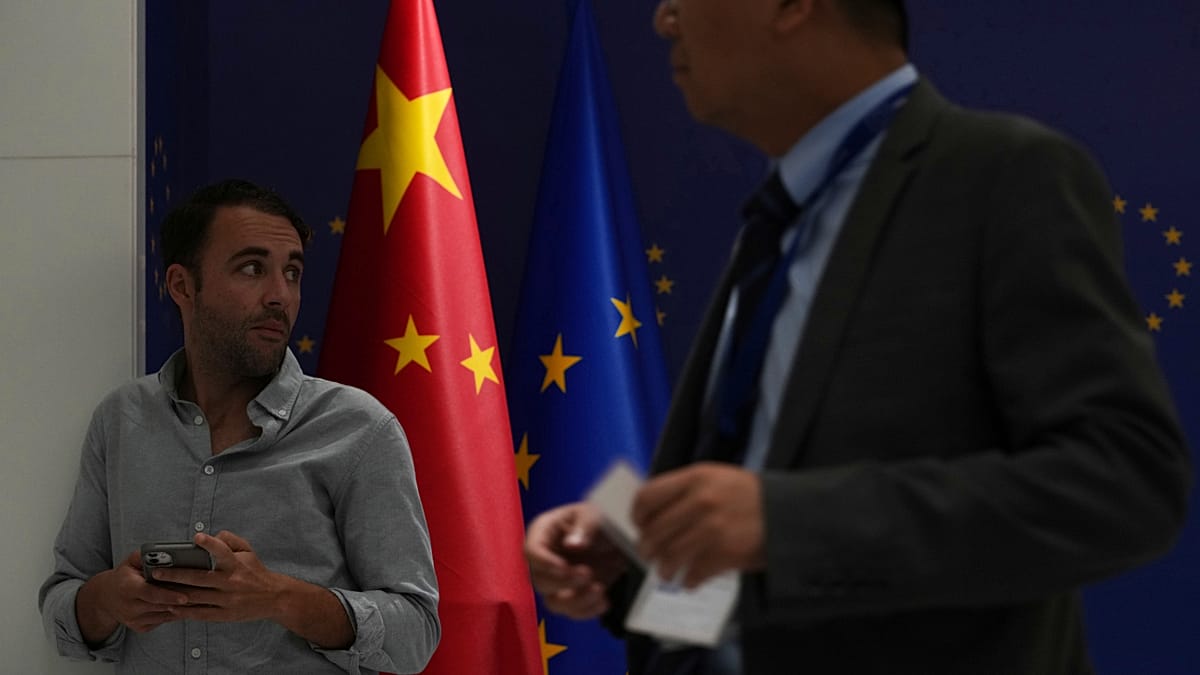
EU-China trade relations are described as "not sustainable," with Brussels weighing tougher trade defenses after a record €359.9 billion EU trade deficit with China. The EU is moving toward higher tariffs, anti-dumping actions, investment screening, and possible restrictions on Chinese suppliers such as Huawei, ZTE and EV-related imports, while Beijing is threatening retaliation and has already hit EU pork, brandy and dairy. The escalating standoff could materially affect autos, industrials, semiconductors, critical raw materials and broader European supply chains.
The market is underpricing how quickly EU-China policy can migrate from rhetoric to balance-sheet impact. The key second-order effect is not a blanket trade war, but a series of sector-specific frictions that raise input costs and procurement risk for European autos, industrials, and telecom/infrastructure, while forcing Chinese exporters to reroute surplus into already weak EU price-sensitive categories. That mix is bearish for margins across the European value chain and likely supportive for domestic EU substitution plays only if policy can be executed fast enough.
The most important catalyst path is regulatory, not tariff-based. A broader use of safeguards, procurement restrictions, and cybersecurity exclusions would hit Chinese hardware, e-commerce, and EV supply chains with a lag of weeks to months, but the market impact should show up immediately in European OEM supplier multiples as investors price in higher chip, battery, and component redundancy costs. Germany is the swing factor: if Berlin shifts even partially, the probability of a coordinated EU response rises materially; if it holds the line, Brussels likely defaults to noisy but incremental measures that are less damaging to China and more damaging to EU corporate planning.
JD is a tactical loser here because the EU is signaling a more hostile posture toward Chinese platforms and acquisition pathways, which raises compliance, payment, and logistics friction for cross-border expansion. The larger bear case is on EU auto suppliers and industrials exposed to China sourcing, where the real risk is not just tariffs but denial of critical inputs and forced inventory buffers that compress ROIC over the next 2-4 quarters. The contrarian view is that this may be a headline-heavy but implementation-light cycle; if policymakers fail to use coercive tools decisively, the best short candidates could squeeze on any “dialogue” reset, while the more durable alpha may come from owning volatility rather than directional equity beta.
AI-powered research, real-time alerts, and portfolio analytics for institutional investors.
Request DemoOverall Sentiment
strongly negative
Sentiment Score
-0.65
Ticker Sentiment
