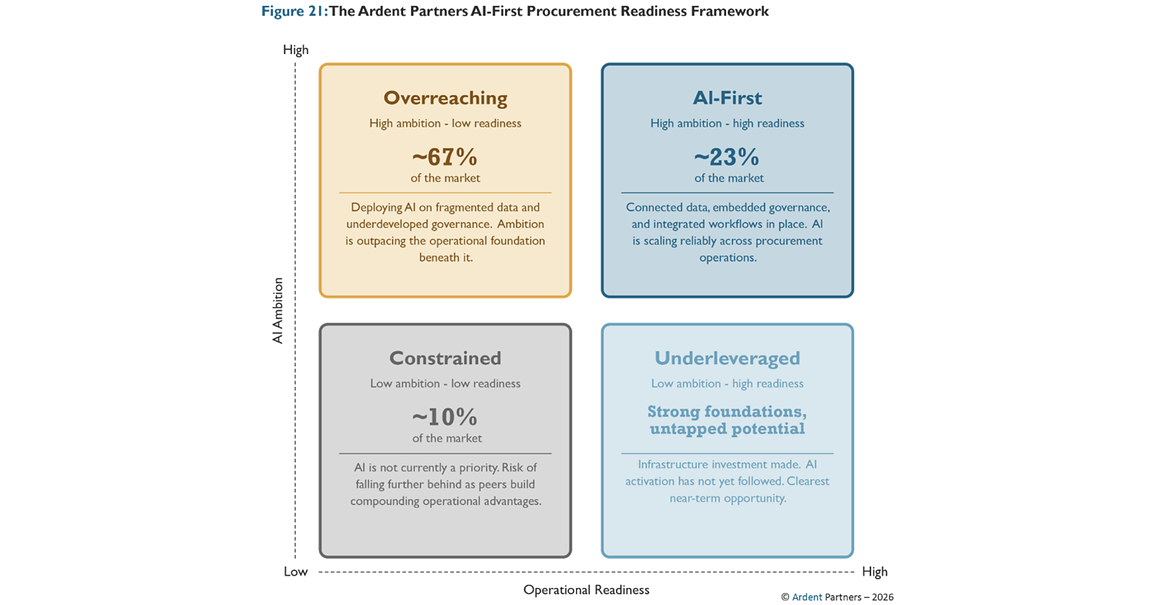
Research finds 67% of procurement teams have high AI ambitions but are not ready to scale, with 59% citing poor data quality/structure/availability as the top blocker and 34% lacking formal AI governance. Only 23% report successfully scaling “AI-First” procurement via strong data foundations and embedded governance, while 47% target cognitive augmentation in a human-agent model. The data suggests near-term deployment gaps (e.g., contract lifecycle management planned 56% vs 14% in use), tempering expectations for near-term, broadly scalable ROI.
This is less a demand-surge story than a budget reallocation toward data plumbing. In procurement, AI monetization will accrue first to platforms already embedded in workflows and master data, while bolt-on copilots face the classic enterprise trap: pilots are easy, production is hard, and the approval layer slows conversion.
The second-order winners are ERP/procurement suites, integration layers, and consulting/service firms that clean up data and define governance. The losers are point solutions and pure AI narrative names that need a seamless data model to prove ROI; in a control-heavy function, black-box concerns should lengthen sales cycles and keep contract values small until vendors can show auditability and human-in-the-loop controls.
Consensus is likely overestimating how quickly procurement AI becomes revenue. The near-term catalyst is commentary, not earnings: expect vendors to talk up pilots over the next 1-2 quarters, but the real test is 2H26 booking conversion and module expansion. Falsifiers include sustained acceleration in procurement-specific ARR or evidence that buyers will accept autonomous workflows without manual approval, which would compress the governance premium.
AI-powered research, real-time alerts, and portfolio analytics for institutional investors.
Overall Sentiment
mildly negative
Sentiment Score
-0.18
Ticker Sentiment
