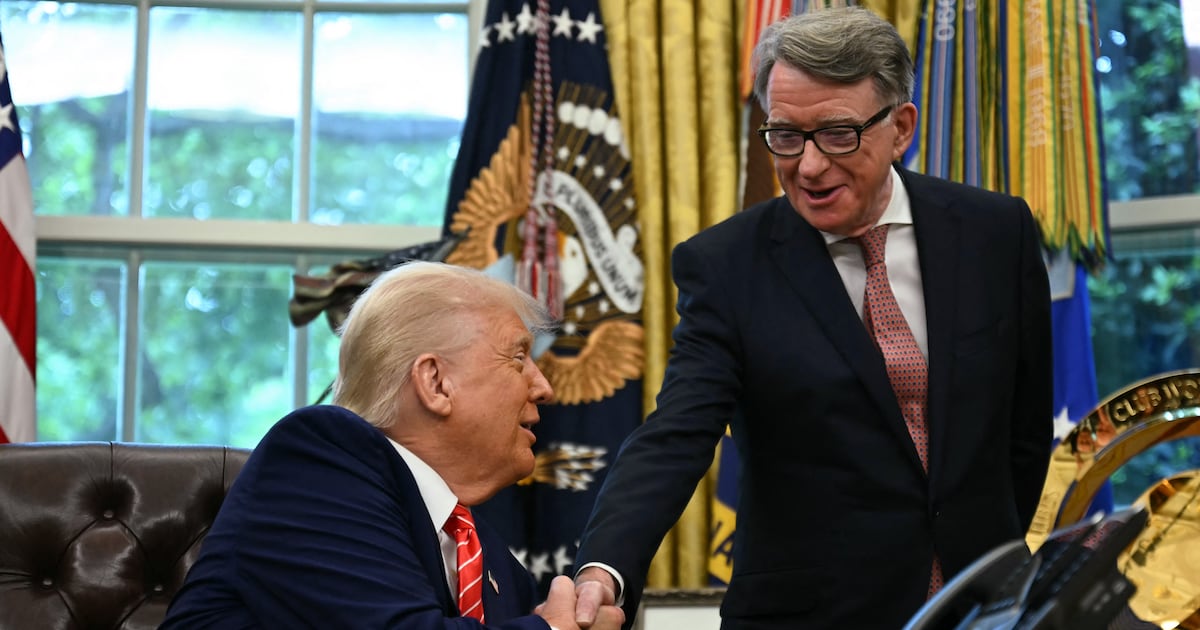
Trump’s attack on UK Prime Minister Keir Starmer comes amid a worsening political dispute over the firing of Peter Mandelson, whose appointment as ambassador to Washington was overridden despite security concerns tied to Jeffrey Epstein. The episode raises governance and reputational risks for Starmer’s Labour government and adds strain to the U.K.-U.S. relationship, including trade and Iran policy tensions. Market impact is likely limited, though the political noise could marginally affect sterling and UK sentiment.
This is less about one compromised appointment than a deterioration in decision quality inside Downing Street, and markets should read it as a governance discount widening across UK-facing assets. When a leadership team is forced into defensive mode, policy bandwidth shrinks, and that typically shows up first in slower deal execution, more erratic messaging on trade, and a higher probability of tactical concessions being mispriced as strategy. The immediate second-order effect is a higher risk premium on UK equities with meaningful US revenue exposure if trade relations remain a political football.
The more interesting spillover is that this creates asymmetry for sectors that rely on stable transatlantic diplomacy: defense, pharma, financials, and industrials with cross-border regulatory needs. If the relationship between Washington and London continues to sour over the next 4-12 weeks, even a modest delay in trade implementation or tariff rhetoric can compress multiples for UK domestics more than macro fundamentals would justify. Conversely, any attempt by Starmer to reset the relationship through policy concessions could create brief relief rallies, but those are likely to be sold unless accompanied by personnel changes that restore credibility.
A contrarian read is that the scandal may actually reduce tail risk for markets in one narrow sense: it weakens the probability of a durable, personality-driven policy arrangement and pushes the system back toward institutions. That said, the near-term path is messy, and the bigger issue is not the ambassador scandal itself but the signal that internal checks were overridden. If that pattern repeats, investors should expect more political volatility around foreign policy, trade, and regulatory appointments into year-end.
The cleanest trade is not on the politics directly but on dispersion: long globally diversified UK earners and short domestic UK cyclicals or politically sensitive midcaps. This is a 1-3 month setup, with the best entry on any relief bounce after headlines fade, because the market usually underestimates how long governance damage lingers in the risk premium.
AI-powered research, real-time alerts, and portfolio analytics for institutional investors.
Request TrialOverall Sentiment
mildly negative
Sentiment Score
-0.30
