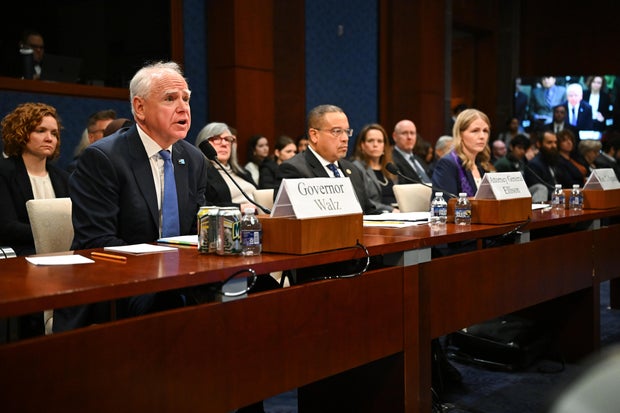
At a House Oversight hearing, Minnesota Gov. Tim Walz and Attorney General Keith Ellison were pressed over a reported $250 million fraud tied to the nonprofit Feeding Our Future and accused by Republicans of lying about knowledge and retaliating against employees; GOP members sought sworn depositions. Walz and Ellison defended their responses and criticized the Trump administration's Operation Metro Surge immigration enforcement for disrupting local fraud investigations, while Democrats highlighted federal funding cuts and civil‑liberties concerns; the episode raises political and governance risk for Minnesota but is unlikely to move broader financial markets.
MARKET STRUCTURE: This hearing is a political/legal shock localized to Minnesota with limited national market disruption, but it reallocates near-term fiscal and contracting flows: increased federal enforcement (or backlash to it) creates short-term procurement demand for security, surveillance and analytics contractors while tightening state-level social-service contracts. Expect winners in defense/contractor names with existing DHS/DOJ footprints (LHX, LDOS, PLTR) and losers among small, state-dependent education/service vendors and nonprofits that rely on low-margin state grants.
RISK ASSESSMENT: Tail risks include a large DOJ/state civil recovery (> $250–500m), aggressive federal/state procurement reforms, or political escalation that pressures Minnesota’s general obligation paper to underperform peers (a 10–50bp muni spread widening scenario). Immediate (days) volatility will be headline-driven; short-term (weeks–months) risks include subpoenas and depositions that produce sell-side re-ratings; long-term (quarters–years) risks are tighter procurement rules and reputational damage that reduce recurring state contract revenue by an estimated 10–30% for exposed vendors.
TRADE IMPLICATIONS: Tactical plays favor 3–6 month exposure to defense/analytics contractors: initiate 1–2% long positions in LDOS and LHX and protected upside via call spreads (see decisions). Reduce exposure to long-duration munis by 1–3% of portfolio and shift into ultra-short Treasury/short-duration muni funds to hedge potential 10–50bp spread widening. Avoid idiosyncratic long exposure to small-cap education tech or social service contractors with >30% revenue from Minnesota unless they can prove contract diversification within 60 days.
CONTRARIAN ANGLES: Consensus frames this as purely political theater; that understates procurement flow shifts — if Operation Metro Surge is re-scoped or repeated elsewhere, vendors with federal contracts could see material revenue re-acceleration (+5–15% YOY in affected units). Conversely, if federal enforcement is curtailed and subpoenas produce large recoveries, small state-exposed vendors will be oversold; look for dislocations in small-cap education services to buy at >30% drawdowns relative to peers once regulatory clarity emerges.
AI-powered research, real-time alerts, and portfolio analytics for institutional investors.
Request TrialOverall Sentiment
moderately negative
Sentiment Score
-0.30
