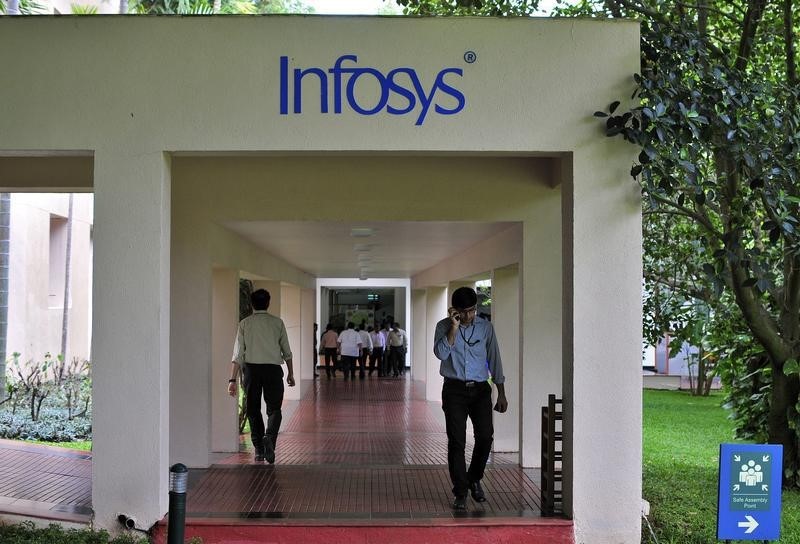
BMO Capital cut Infosys's price target to $15 from $20 while keeping a Market Perform rating, citing weaker FY2026 constant-currency revenue growth and FY2027 guidance that missed expectations. The firm highlighted ramp-down risk from a large European manufacturing client and rising competitive pressure in AI-led services, while remaining skeptical that AI services will meaningfully add revenue. The stock trades at $12.95, near its 52-week low of $12.57, despite a stated fair value estimate of $18.97.
This read-through is less about one consultancy miss and more about a deteriorating demand elasticity story in large-cap IT services. When management guides conservatively into a still-solid revenue print, the market is signaling that pricing power is weakening faster than utilization can offset it, which usually compresses valuation multiples well before earnings actually roll over. The key second-order effect is that AI efficiency gains may not create a new revenue pool; they can instead become a deflationary force that lets customers demand more scope for the same budget, pressuring peers that are most exposed to discretionary transformation spend.
The real loser set is likely the lower-tier global delivery players and India-centric digital services names with similar client mix but less balance-sheet flexibility. If one large manufacturing client is ramping down, the market should worry about broader enterprise budget scrutiny in Europe and industrial verticals, where cost takeout projects often get repriced first in a slowdown. That creates a lagged margin risk over the next 2-3 quarters: revenue growth can decelerate before headcount and SG&A reset, causing multiple compression even if reported EPS holds up near term.
The contrarian angle is that the stock may already be pricing in too much gloom if the business can stabilize constant-currency growth and convert AI into attached services rather than standalone monetization. In other words, the bear case assumes AI is purely disintermediating; a more balanced view is that incumbents with delivery scale can capture migration, governance, and integration spend even if the headline service mix shifts. But until guidance inflects, the burden of proof remains with management, and any rally on macro risk-on should be sold into rather than chased.
Catalyst-wise, the next 30-60 days matter most for estimate cuts and sell-side model resets; the 6-12 month window matters for whether AI-led productivity becomes visible in bill rates and headcount leverage. A failure to reaccelerate bookings in the next two quarters would likely force another leg lower in both estimates and the multiple, while evidence of pricing stability would quickly support a short-covering move off the lows.
AI-powered research, real-time alerts, and portfolio analytics for institutional investors.
Request TrialOverall Sentiment
mildly negative
Sentiment Score
-0.25
Ticker Sentiment
