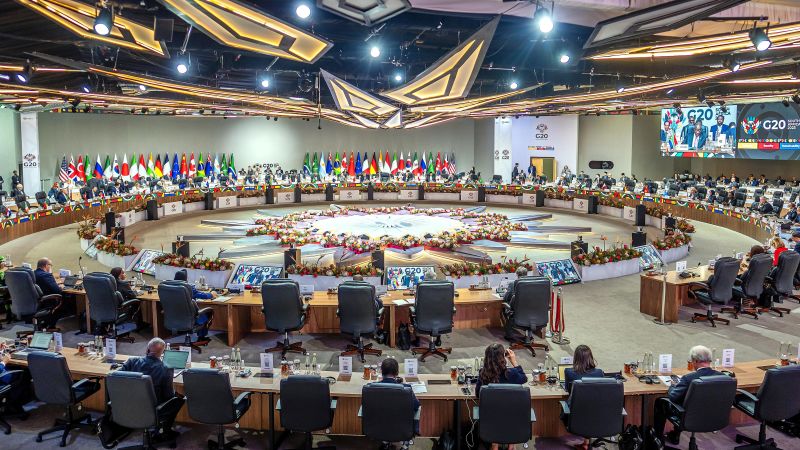
The Johannesburg G20 concluded amid a conspicuous U.S. boycott after the Trump administration declined to send accredited officials, denying the customary on-stage handover to the next G20 president and underscoring geopolitical frictions. South Africa pushed through a 122-point leaders' declaration focused on climate action, inequality, debt relief and support for poorer nations despite U.S. and Argentina opposition, but left out some concrete proposals such as a new international panel on wealth inequality. The summit's symbolic focus on the Global South and green transition may shape future development and financing discussions, yet the U.S. absence highlights fractures that limit the G20's capacity for coordinated responses to geopolitical crises and large-scale policy initiatives.
Market structure: Fragmentation of multilateral policy reduces the probability of coordinated large-scale IMF/World Bank-led relief, raising risk premia for weaker sovereigns and making private capital and bilateral green finance relatively more important. Expect demand shift toward critical-minerals and renewables supply chains (equipment makers, miners) as Global South seeks direct financing; this should increase pricing power for upstream miners and project developers over 12–36 months. FX and bond flows will bifurcate — safe-haven TBills/Treasuries bid in stresses while EM FX and sovereign curves face volatility and higher term premia.
Risk assessment: Tail risks include a political escalation that triggers sanctions or trade frictions (low-prob but high-impact on commodity/logistics chains) and a disorderly sovereign restructuring wave if relief stalls, which could widen EMBI spreads by 200–400bp in worst-case scenarios. Near-term (days–weeks) risk is repricing around headlines; medium-term (3–12 months) risk is higher default and rating downgrades concentrated in dollar-denominated, fiscally stretched EMs. Hidden dependencies: project-level renewables in EMs rely on concessional FX lines and political guarantees — cuts there amplify developer counterparty risk.
Trade implications: Tactical long exposure to copper/lithium miners (COPX, LIT) and select solar equipment (FSLR) for 12–36 months; hedge EM equity/bond beta with short-duration protection (puts on VWO or EMB) over 3–6 months. Use options to manage skew: buy 3-month put spreads on VWO (5–10% OTM) and buy 6–12 month call exposure on COPX/LIT to capture structural demand while limiting capital at risk. Rotate away from EM sovereign debt beta into project finance, critical minerals, and developed-market renewables suppliers.
Contrarian angles: Markets may overprice systemic EM debtloss; bilateral green funding (China, GCC) and private credit funds could fill gaps, creating idiosyncratic winners among developers with bankable PPAs. The consensus of broad EM underweight may underappreciate select names with hard-currency offtakes or export-linked receipts — look for developers/miners with >50% USD revenue. Unintended consequence: fragmented aid could boost private credit returns and carve-out opportunities for specialist lenders over 12–24 months.
AI-powered research, real-time alerts, and portfolio analytics for institutional investors.
Request DemoOverall Sentiment
neutral
Sentiment Score
-0.12
