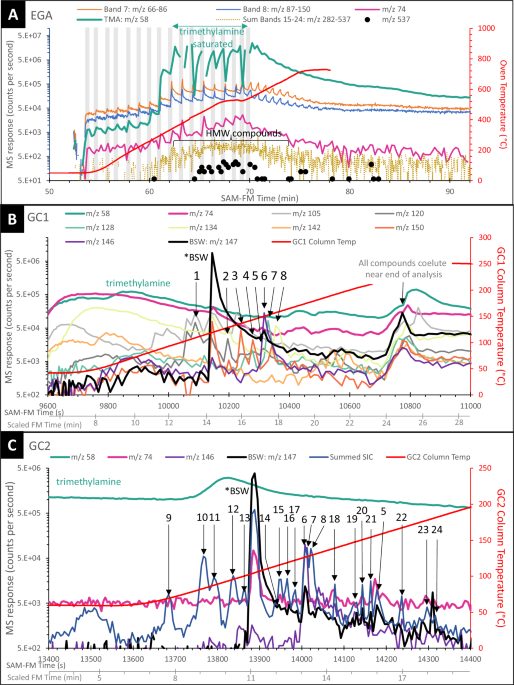
Curiosity’s first in situ SAM TMAH experiment on Mars detected more than 20 organic molecules, including confirmed benzothiophene, naphthalene, methyl benzoate, and methylnaphthalene. The results indicate ancient macromolecular organic matter was preserved in ~3.5-billion-year-old Gale crater sediments despite long-term diagenesis and radiation exposure. Scientifically significant, but with limited direct market relevance outside space and instrumentation technology.
This is less about “Mars news” and more about a platform-validation event for analytical chemistry in extreme environments. The key commercial implication is that wet-chemistry thermochemolysis is now de-risked as a method for extracting signal from heavily aged, low-yield samples — a capability that translates directly into future mission design, especially where payload mass and contamination budgets are binding constraints. The winner set is the small ecosystem of space analytical instrumentation, high-reliability chromatography, sample prep, and contamination-control suppliers; the loser set is any competing approach that depends on simple pyrolysis alone to find organics in degraded matrices.
The second-order effect is on mission architecture, not just scientific upside. Once the community accepts that derivatization materially expands detectable molecular space, future instruments will bias toward reagent-enabled workflows, which increases system complexity but lowers the probability of null results on valuable samples. That raises the expected value of sample-return and in situ life-detection programs over a multi-year horizon, because the main failure mode shifts from “no organics preserved” to “organics present but not chemically liberated,” a solvable engineering problem.
Contrarianly, the market may underappreciate how this narrows the gap between rover science and lab-grade geochemistry. The immediate upside is not a sudden step-function in astrobiology odds; it is a higher detection rate for chemically bound molecules, which can materially improve discovery frequency and funding durability. The biggest reversal risk is if subsequent optimized runs fail to reproduce the yield at scale, in which case this becomes a one-off science result rather than a platform inflection.
AI-powered research, real-time alerts, and portfolio analytics for institutional investors.
Request TrialOverall Sentiment
mildly positive
Sentiment Score
0.20
