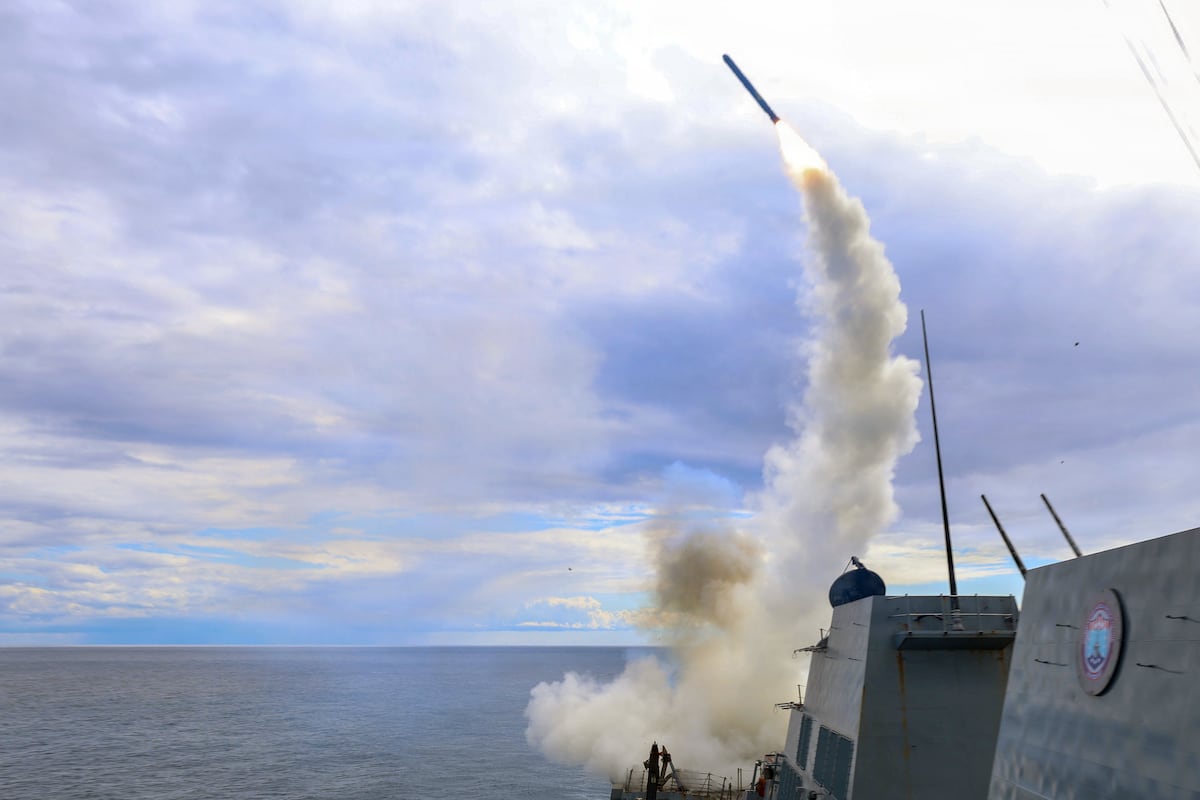
CSIS estimates the U.S. needs at least three years to restore key weapons inventories after its 38-day bombing campaign against Iran, with more than 1,000 Tomahawks and up to 290 THAAD interceptors expended. Replenishment of Tomahawks could take until 2030-2031, while THAAD stocks may not return to prior levels until mid-to-late 2029, creating a multi-year window of vulnerability. The report underscores that the constraint is production time, not money, even as the Pentagon says rebuilding is underway and defense contractors are being pushed to expand capacity.
The market implication is less about the just-completed conflict and more about a multi-year air-defense inventory reset that now looks structurally slower than the threat cycle. That tends to favor primes with high-margin missile, radar, and integrated air-defense exposure over platform-heavy names, because the budget response will likely prioritize replenishment of scarce interceptors and seekers before new-airframe discretionary spending. The second-order effect is that U.S. and allied planners will likely try to rebuild through multi-year procurement and industrial base expansion, which supports backlog visibility but also creates execution risk from labor, sub-tier electronics, energetics, and rocket motor bottlenecks. The biggest near-term winner is the supplier chain behind interceptors and maritime strike weapons, but the dispersion matters: names with chokepoint content and installed manufacturing capacity should outperform those simply exposed to headline defense spending. For Boeing, the signal is mildly positive only through munitions and defense services rather than commercial aerospace; for Lockheed, the negative read-through is not demand destruction but margin pressure if production ramps faster than the supply chain can absorb, especially in complex missile-defense lines. Northrop sits in the middle: better positioned than pure airframe exposure if the Pentagon leans into command-and-control, sensors, and integration, but still vulnerable if funding is diverted toward replenishment rather than new starts. The contrarian issue is that consensus may be overstating the immediacy of a “stockpiles are empty” trade. The U.S. likely has enough for current contingencies, so the true market catalyst is not a sudden operational shortfall but a sustained appropriation cycle and contract awards over the next 6-18 months. If production expansion is announced but unit economics deteriorate or Congressional funding gets delayed, these stocks can give back quickly because the valuation case depends on durable backlog conversion, not just rhetoric. A more interesting second-order hedge is geopolitical deterrence: if allies perceive the U.S. as temporarily inventory-constrained, they will front-load their own purchases, supporting export demand for air-defense and missile systems. That creates a multi-year tailwind for companies with international channel access and production flexibility, while increasing pressure on lower-quality subcontractors and any business with fixed-price exposure.
AI-powered research, real-time alerts, and portfolio analytics for institutional investors.
Request DemoOverall Sentiment
moderately negative
Sentiment Score
-0.25
Ticker Sentiment
