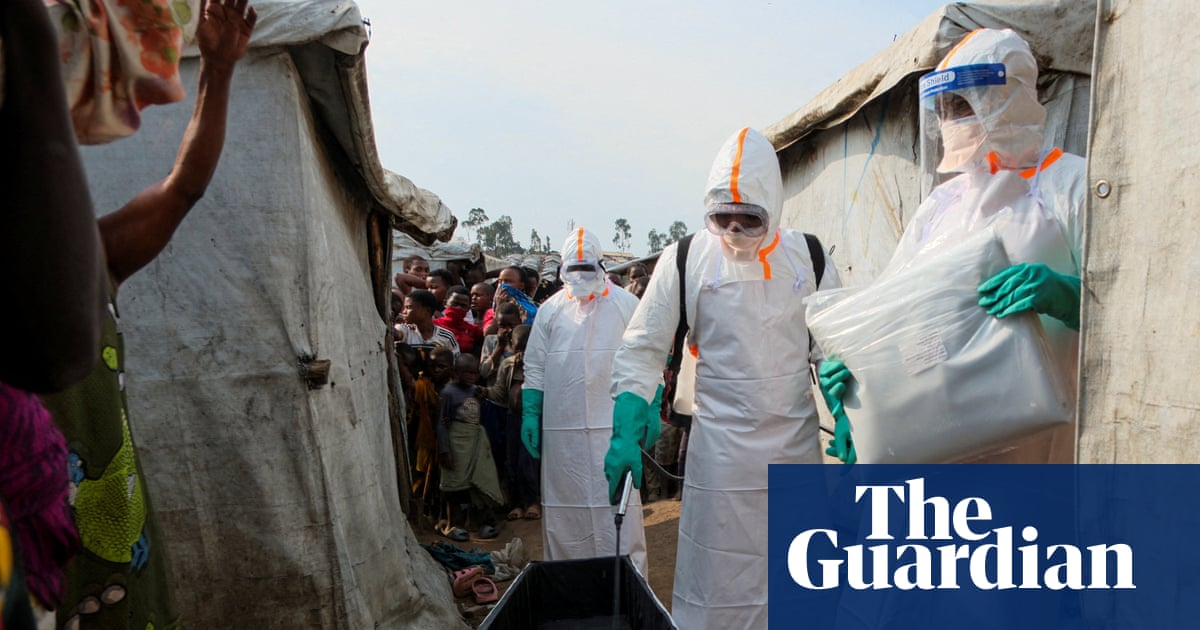
The DRC Ebola outbreak remains severe, with 1,118 confirmed cases and 291 deaths, while nearly 300 infected people are unaccounted for and 1 million displaced people remain out of health-worker reach. WHO modelling points to 8,210 cases and 1,420 deaths by mid-September, with a 70% chance of spread to South Sudan. Authorities are tightening movement restrictions, and new treatment and prophylaxis trials are due to begin next week, but the outbreak is still expanding under conflict-driven access constraints.
This is less a pure bio-event than a conflict logistics shock. The second-order effect is that every incremental case now has a higher effective reproduction rate because containment capacity is constrained by access, not just medicine; that shifts the regime from “epidemiology-led” to “security-led” until humanitarian corridors improve. In that setup, the market tends to misprice duration: the first reaction is usually local, but the larger risk is a multi-month drag on regional activity, border friction, and NGO/aid supply chains rather than a short-lived headline spike.
The biggest near-term catalyst is not the case count itself but the interaction between travel controls, cross-border monitoring, and treatment-trial readouts. If contacts are not reliably traceable, the outbreak can overshoot the central scenario even without a dramatic change in virulence, because the bottleneck becomes detection latency. Conversely, any credible access agreement to camps or a rapid scale-up in community health workers could compress tail risk quickly; this is a classic “operations beat biology” setup where a modest improvement in field execution can matter more than an additional antiviral.
For public markets, the cleanest expression is via risk assets with EM or Africa exposure rather than direct Ebola beneficiaries, which are too small and illiquid to matter. Expect pressure on airlines, regional banks, and frontier-market debt proxies if the story migrates into South Sudan/Uganda and travel restrictions broaden; that risk is highest over the next 2-6 weeks. The contrarian view is that the worst-case case-count models may overstate traded impact because most global investors will treat this as a contained humanitarian crisis unless there is sustained export of cases into major urban or airport nodes.
The more interesting hidden winner is any company with low-friction diagnostic, cold-chain, or field-deployment capabilities, because governments and NGOs will likely fast-track procurement under emergency conditions. But the bigger alpha is in avoiding crowded “pandemic hedge” longs that only work if the outbreak becomes global; this setup is more likely to produce localized volatility and repeated false starts than a pandemic-style rerating. If the response funding gap persists into the next 2-4 weeks, expect headlines to stay negative and the probability of policy escalation to rise materially.
AI-powered research, real-time alerts, and portfolio analytics for institutional investors.
Request DemoOverall Sentiment
strongly negative
Sentiment Score
-0.78
