
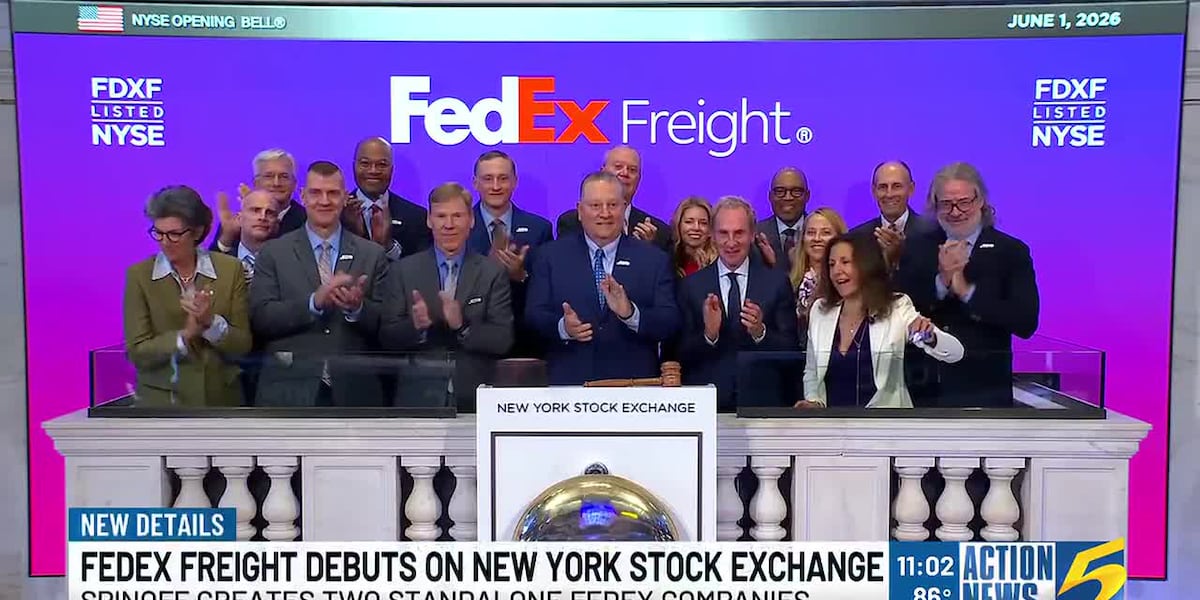
FedEx has completed the spin-off of FedEx Freight, which will begin regular-way trading Monday on the NYSE under ticker FDXF, while FedEx remains FDX. Shareholders received 1 FedEx Freight share for every 2 FedEx shares held as of May 15, and FedEx retained a 19.9% stake it plans to sell within two years. The separation creates two standalone companies and is positioned as a long-term value-creation event for shareholders.
The split is less about corporate simplification than about forcing a cleaner valuation bifurcation. FedEx is effectively shedding a lower-growth, capital-intensive asset whose cycle is driven by industrial freight demand rather than parcel pricing, while the remaining network can now be judged on margin discipline and cash conversion without the drag of an LTL re-rating overhang. That should help both stocks in the near term: the parent gets a multiple reset if management can show better ROIC, while the new freight company may attract a dedicated industrial/logistics investor base willing to underwrite cyclical upside.
The second-order issue is not operational but balance-sheet and supply-chain behavior. A standalone freight carrier with public market pressure is likely to be more aggressive on pricing, density, and network utilization during a soft freight tape, which could intensify competition for peers in LTL and regional networks over the next 2-6 quarters. If freight demand weakens, the market may also discover that the residual value of the retained 19.9% stake is a timing overhang: forced monetization within two years could create incremental supply and pressure the parent’s capital allocation narrative.
The cleanest read-through is that this is mildly bullish for FDX only if the market believes management will redeploy proceeds into buybacks or higher-return assets rather than absorb them into lower-return network spending. The bigger upside may actually be in the spun entity if it trades at a discount-to-peers initially and the company proves it can maintain rate discipline through a freight downcycle. The contrarian risk is that investors overestimate separation benefits: if macro freight volumes deteriorate, both names can underperform because the spin does not create demand, only refocuses exposure.
AI-powered research, real-time alerts, and portfolio analytics for institutional investors.
Request TrialOverall Sentiment
mildly positive
Sentiment Score
0.24
Ticker Sentiment
