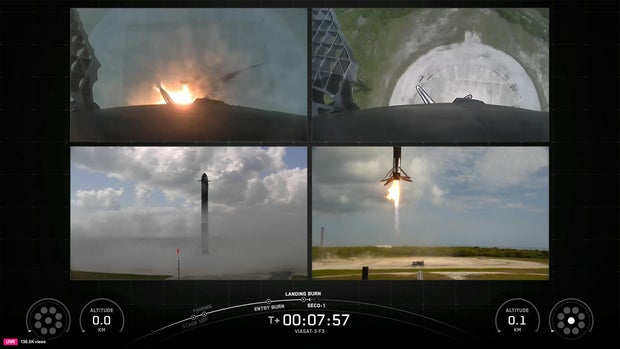
SpaceX completed its 12th Falcon Heavy launch, successfully deploying ViaSat-3 Flight 3 into preliminary orbit and recovering both side boosters on target. The satellite is designed to provide up to 1 terabyte per second of capacity and expand coverage across Asia and the Pacific once it reaches geosynchronous orbit. The mission is a positive operational milestone for SpaceX and ViaSat, but it is routine enough to have limited broad market impact.
VSAT is the cleanest beneficiary, but the bigger signal is that the company is still operating a capital-intensive, highly timing-sensitive model where a single deployment issue can swing service quality for quarters. The market should care less about the launch event itself and more about whether the new bird actually restores enough usable capacity to improve pricing power and reduce churn in enterprise/government mobility contracts; if it does, the operating leverage can show up quickly because incremental capacity in GEO is scarce and expensive to replace.
The competitive read-through is more nuanced for AMZN. LEO constellations win on latency and flexible deployment, but the ViaSat model still has a moat in broad-area, high-throughput coverage where customers care more about bandwidth density than milliseconds of latency. That means the near-term threat is not wholesale displacement, but selective share loss in consumer broadband and maritime/aviation markets where LEO pricing can undercut legacy GEO economics over 12-24 months.
BA and NOC get a modest but real second-order boost from the ongoing normalization of heavy-lift launch demand and large-spacecraft procurement. The bigger implication is that space infrastructure remains bifurcated: launch cadence is increasingly commoditized, while mission-critical satellite hardware still carries meaningful single-point-of-failure risk, which supports suppliers with differentiated payload integration and deployable structures. The market may be underestimating how much this reinforces the value of proven aerospace subsystems versus headline-grabbing launch providers.
Contrarianly, the setup is not uniformly bullish: success here could still be a sell-the-news event if investors were already positioned for a recovery in VSAT after prior satellite disappointments. The key catalyst window is 1-3 months, when early orbit checkout and service activation will determine whether this becomes a margin recovery story or just another balance-sheet-intensive asset turn. A failure would be especially punitive because it would likely compress the perceived probability of the full GEO fleet ever earning its cost of capital.
AI-powered research, real-time alerts, and portfolio analytics for institutional investors.
Request DemoOverall Sentiment
mildly positive
Sentiment Score
0.25
Ticker Sentiment
