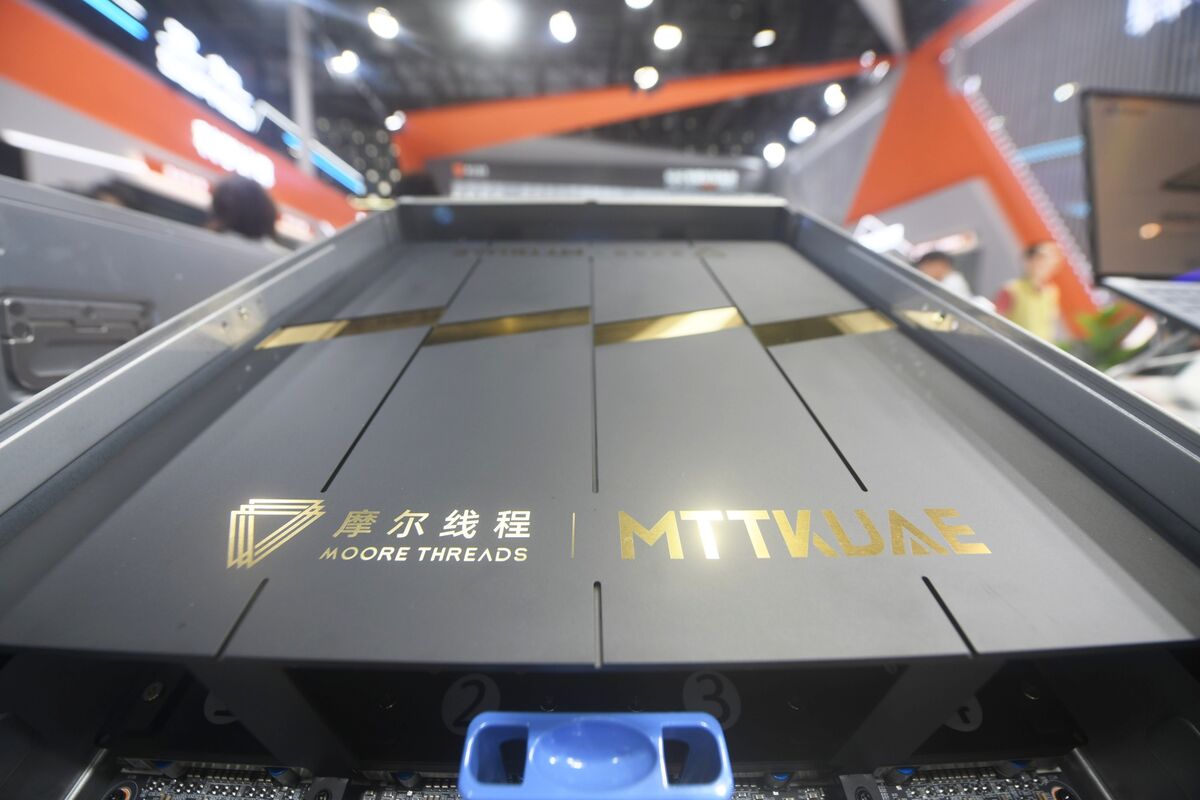
Moore Threads Technology Co., a Chinese artificial intelligence chipmaker, raised 8 billion yuan ($1.13 billion) in an onshore IPO and saw its Shanghai-listed shares surge as much as 502% from the 114.28 yuan IPO price on debut. If sustained, the move would be the largest first-day pop for an IPO over $1 billion since China’s 2019 IPO reforms, signalling exceptionally strong investor appetite for domestic AI chip plays and potential re-rating of comparable listings and future IPO allocations in China.
Market structure: A 502% IPO pop on a ¥8bn deal signals extreme retail-driven re-pricing of China AI chip expectations; immediate winners are domestic AI IP/software vendors, listed peers on STAR (e.g., Cambricon 688256.SH) and brokerages capturing flow, while legacy foundries (SMIC 981.HK) face stretched valuation narratives if capacity cannot scale. Pricing power shifts toward design/IP-rich players vs commoditized fabs; expect short-term demand > supply for marquee domestic AI chips, but sustainable share gains require fabs or advanced nodes from TSMC (2330.TW) which remain a bottleneck.
Risk assessment: Tail risks include tightened export controls (US/EU) or PRC regulatory measures targeting speculative IPO froth, secondary offerings/lock-up sells within 3–6 months, and operational failure of Moore Threads to deliver silicon — any of which could trigger 50–80% downside in small-cap names. Time horizons: mean reversion likely in days–weeks; sector re-rating could last 3–12 months if real contracts follow; secular demand for AI accelerators supports multi-year upside for true moats (NVDA, TSMC).
Trade implications: In the next 5–21 trading days, fade retail euphoria via protective downside positions on China tech ETFs (KWEB, ASHR) and small-cap STAR baskets; medium-term (1–6 months) overweight leaders with manufacturing/moat (NVDA, 2330.TW) and selective domestic IP plays (688256.SH) sized 1–3% each. Use options to limit capital: buy puts or put spreads on KWEB (3-month, 20–30% OTM) and buy call spreads on NVDA (3–6 month) to express asymmetric exposure.
Contrarian angles: Consensus assumes every Chinese AI chip IPO is a winner — that ignores fabs, node access, and customer wins; reaction is likely overdone for pure-design or pre-revenue issuers. Historical parallels: 2019 China IPO froths that collapsed after lock-ups and delivery misses; unintended consequences include capital chasing hollow stories, bid/ask blowouts, and forced deleveraging in margin-heavy retail channels that can exacerbate drops >60% in 1–2 months.
AI-powered research, real-time alerts, and portfolio analytics for institutional investors.
Request DemoOverall Sentiment
strongly positive
Sentiment Score
0.85
