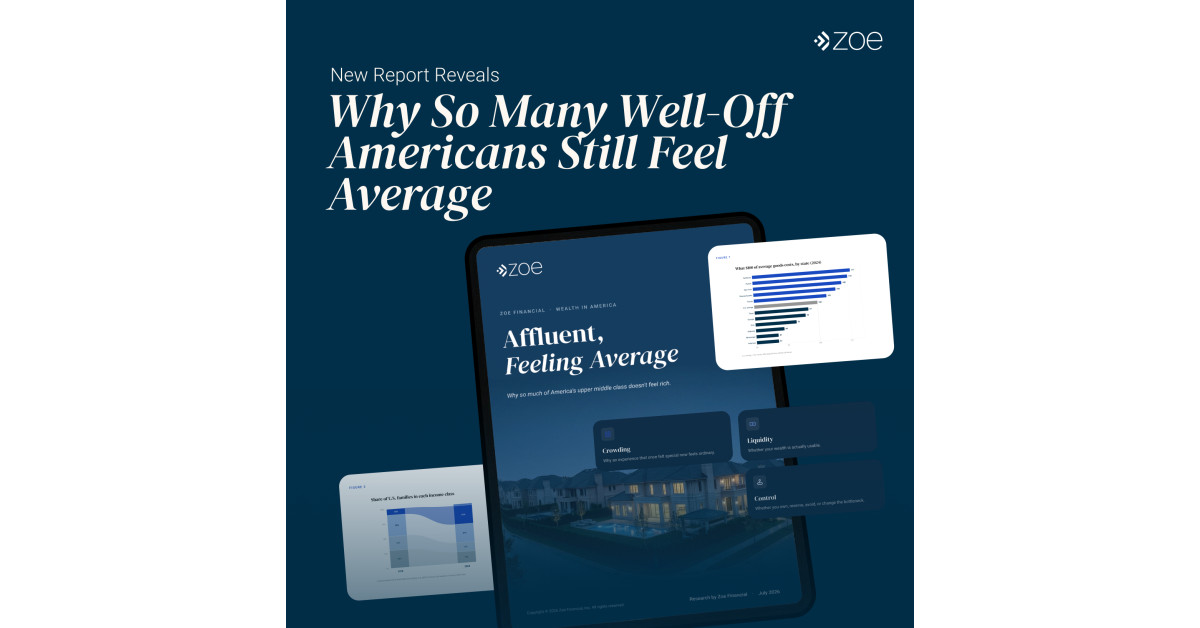
Zoe Financial released its “Affluent, Feeling Average” report, finding that Americans may still feel average even after reaching ~$2.3M to feel “rich” and ~$839,000 to feel “comfortable.” The study attributes this gap to social comparison (upper middle class tripled since 1979) and the fact that wealth often sits in housing and 401(k)s rather than readily usable assets. Alongside the report, Zoe launched a free interactive net-worth comparison tool using real income/net-worth data by age.
This reads more like lead-gen and brand-positioning than an investable demand shock. The commercial upside is modestly positive for fee-based advice, custodians, and planning-led platforms because households with high paper wealth but low perceived liquidity tend to buy certainty: managed accounts, retirement-income planning, tax optimization, and cash-management products. The beneficiary set is therefore closer to SCHW/LPLA/AMP and independent RIAs than to generic consumer names; there is no clean read-through to broad retail demand unless this somehow alters spending behavior, which seems unlikely.
Near term, the effect on earnings is probably negligible. Over 1-3 months, the only real catalyst is whether the content drives measurable advisor inquiries, funded-account conversion, or larger household cash balances; without that, this is just engagement marketing. Over 6-18 months, the structural tailwind is the continuing migration from pensions to self-directed balance-sheet management, which increases demand for advice but also shifts product mix toward liquid, tax-aware solutions and away from opaque, high-fee wrappers.
The contrarian view is that consensus may overread “feeling average” as a macro sentiment warning. The stronger mechanism is wallet-share reallocation inside wealth management, not a broad consumer retrenchment or a rush into risk assets. The thesis is falsified if SCHW/LPLA wealth flows and advisor-related revenue do not improve in the next two quarters, or if inbound lead volume from this initiative proves decorative rather than conversion-driving.
AI-powered research, real-time alerts, and portfolio analytics for institutional investors.
Request DemoOverall Sentiment
neutral
Sentiment Score
0.06
Ticker Sentiment
