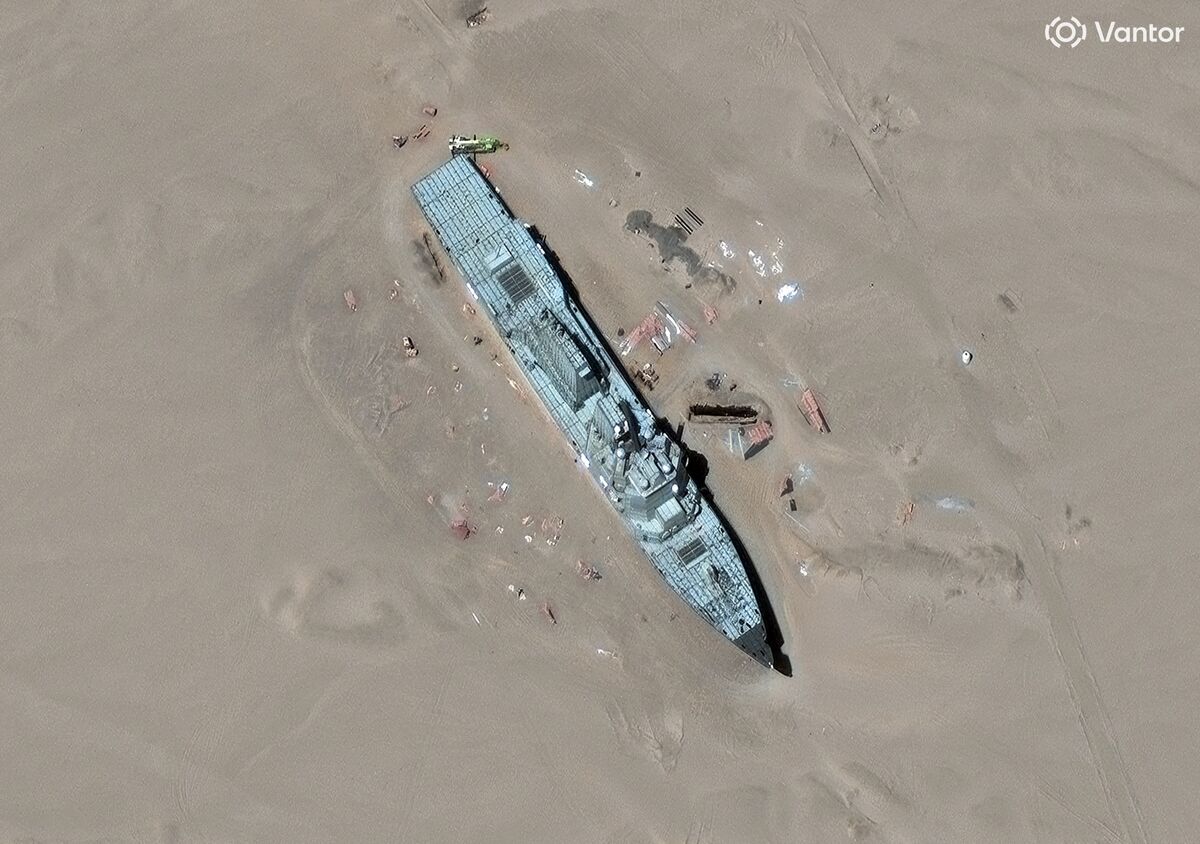
China has built a replica of a US Arleigh Burke-class destroyer at a missile-testing site in Xinjiang, with satellite imagery showing the target in place since at least June. The structure appears designed to support anti-ship missile testing and broader military readiness assessments. The development adds to geopolitical tensions, but the article does not indicate an immediate market-moving event.
This is less about an imminent kinetic escalation and more about China tightening the feedback loop between sensor, seeker, and missile design. A full-scale replica of a high-value surface combatant lets the PLA validate terminal guidance, seeker discrimination, and salvo tactics against a realistic radar cross-section and geometry, which should incrementally improve anti-ship missile effectiveness over the next 12-36 months. The real second-order effect is deterrence: even without a live-fire event, the signaling can force the US Navy and regional allies to spend more on decoys, electronic warfare, distributed lethality, and harder-to-target formations.
The beneficiaries are not the obvious primes alone; the better trade is in the enabling layer. Electronic warfare, passive sensing, decoys, and missile-defense software are more likely to see budget resilience than platform-heavy shipbuilders, because the response to a more credible anti-ship envelope is to make ships harder to kill rather than simply buy more of them. On the supply-chain side, this supports niche RF components, advanced materials, and interceptors with higher software content, while pressuring surface-combatant utilization assumptions if planners decide large deck concentrations are more vulnerable in a Taiwan contingency.
Near term, the market impact should be modest because this is a signaling event, not a procurement surprise. The main catalyst would be a visible jump in PLA live-fire frequency, a new ASBM/ASCM test cadence, or explicit budget commentary from the Pentagon/Japan/ROK around counter-A2/AD investments; that would convert this from background noise into actual order-flow for defense suppliers. The contrarian point is that the move may be underpriced: if the US responds with dispersed maritime ops and more decoys, the first beneficiaries may be cybersecurity, EW, and munitions software, not the headline shipbuilders everyone expects.
AI-powered research, real-time alerts, and portfolio analytics for institutional investors.
Request DemoOverall Sentiment
mildly negative
Sentiment Score
-0.15
