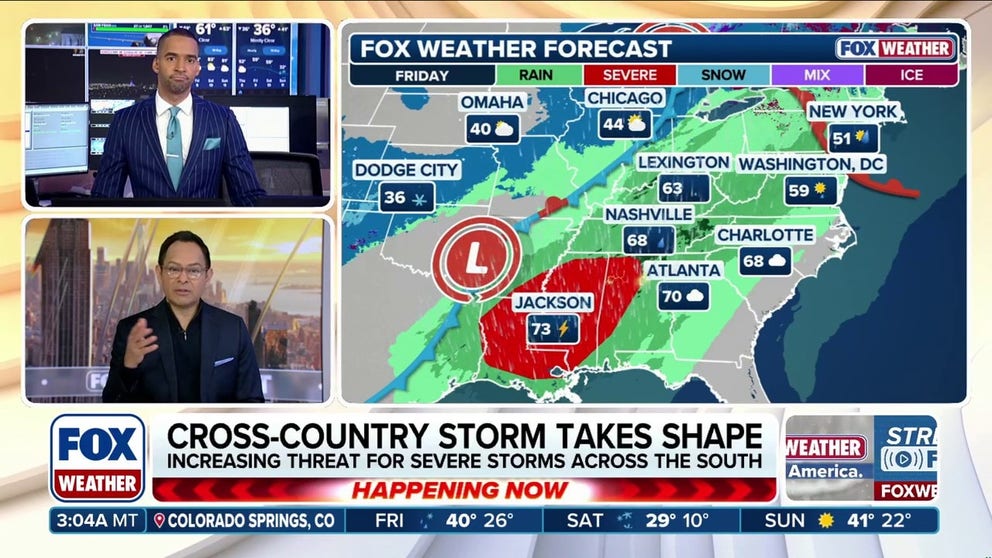
Two back-to-back cross-country storms will move east Thursday–Saturday, producing heavy rain, rounds of snow from the Four Corners to the Great Lakes, and severe thunderstorms across the Mississippi and Tennessee valleys. NOAA and SPC highlight elevated risks: a Level 2/5 severe thunderstorm risk covering more than 8 million people in the Lower Mississippi and Tennessee valleys (including Memphis, Jackson and Baton Rouge), and a Level 2/4 flash-flood threat for Middle Tennessee, Mississippi and northern Alabama with 2–3 inches expected and localized pockets up to 5 inches. Rain will reach the Mid-Atlantic and Northeast Friday and likely linger through Saturday, creating near-term disruption risks for insurers, utilities, regional transport and logistics operations.
Market Structure: Short-term winners are home improvement retailers (HD, LOW) and generator/backup-power suppliers (GNRC) from repair and pre/post-storm purchases, while regional airlines (AAL, UAL), parcel carriers (UPS, FDX) and time-sensitive trucking (JBHT) face immediate volume and on-time-performance hits. Insurers/reinsurers bear concentrated near-term loss exposure in the Lower Mississippi/Tennessee valleys; expect elevated claims flow over weeks that can pressure regional P&C names and cat bond spreads if losses exceed $1–3bn locally. Risk Assessment: Immediate risks (0–7 days) are logistics disruption and airline cancellations; short-term (weeks–months) are loss-adjustment and supply-chain backlogs; medium-term (quarters) include higher materials demand that can boost retail sales but also input inflation. Tail scenarios: a multi-state flash-flood/tornado outbreak causing insured losses >$5–10bn would widen catastrophe reinsurance spreads and widen regional muni credit spreads; hidden dependency is delayed Midwest planting (corn/soy) compressing supply windows. Trade Implications: Tactical ideas include short-dated puts on airlines (AAL, UAL) to capture 5–15% downside from cancellations, 3-month call spreads on GNRC and 3–6 month longs in HD/LOW to capture 8–15% post-storm demand, and a 1–3% tactical long in CORN ETF if planting windows are missed (target 5–10% move). Use options to limit downside: buy 2–4 week puts for airlines, buy 3-month 10–20% OTM call spreads on GNRC/HD; size small (0.5–2% portfolio each). Contrarian Angles: Consensus may underprice agricultural risk — a 1–2 week planting delay in key Midwest zones historically moves CBOT corn/soy by ~5–10% within 4–8 weeks, an outcome markets often miss. Conversely, short-term selloffs in major carriers can be overdone; consider buying airline exposure selectively 4–8 weeks post-storm if capacity-normalization signals appear and ticketing demand rebounds.
AI-powered research, real-time alerts, and portfolio analytics for institutional investors.
Request DemoOverall Sentiment
mildly negative
Sentiment Score
-0.25
