
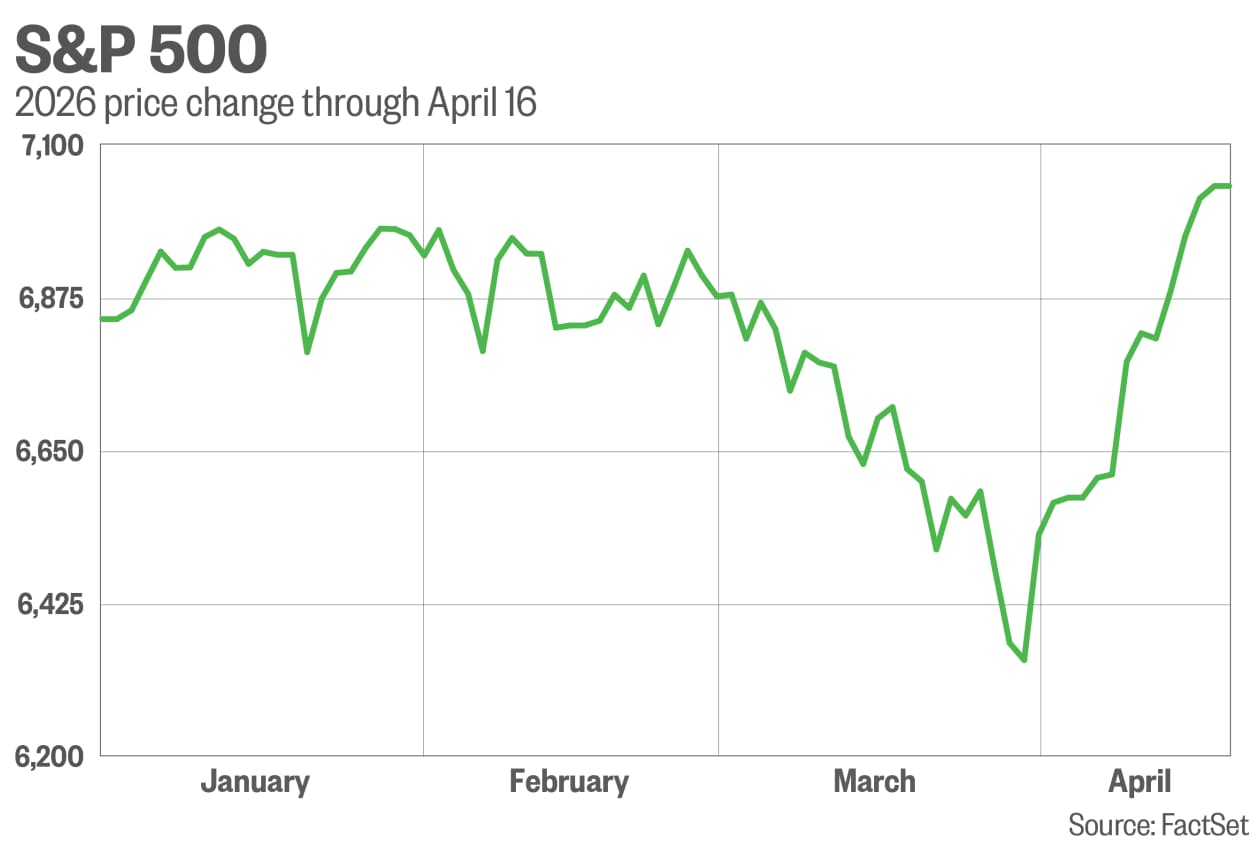
The S&P 500 fell 8% from Feb. 27 through March 30 after the U.S. and Israel launched an attack on Iran, then rebounded to record highs by Wednesday. Despite the index’s quick recovery, 86 S&P 500 stocks declined at least 15% during that period, highlighting broad dispersion beneath the headline index move. The article frames the rebound as a market technical and sentiment story rather than a fundamental earnings update.
The key takeaway is not that the index recovered, but that dispersion stayed high while headline volatility normalized. When the tape snaps back to new highs after a geopolitical shock, the market is telling you that macro hedging demand was temporary, but positioning damage was concentrated in single names; that creates a second-order opportunity in crowded longs that were mechanically de-risked and may still be under-owned. The next leg is likely driven less by war headlines and more by whether systematic and CTA flows re-add exposure into strength, which can keep the index elevated even if breadth remains fragile.
The more interesting setup is in options and volatility. A fast mean reversion typically crushes front-end realized vol faster than implied, especially if the event premium was overpriced, which favors premium-selling in broad indices but not necessarily in the names that were hit hardest. That makes the post-rebound window ideal for dispersion trades: short index vol while staying long single-name vol in sectors where supply chain or procurement risk is still underappreciated.
The contrarian read is that the market may be misclassifying a geopolitical de-escalation as a clean reset when in fact it only bought time. The original drawdown showed that investors were willing to sell risk aggressively on a headline, so any renewed escalation would likely gap lower faster than the first move because liquidity providers will be less confident fading it. Over the next 2-8 weeks, the path of least resistance is still higher for indices, but the payoff distribution is skewed: upside is slow and grindy, downside is sudden and discontinuous.
For SPXC specifically, the lack of an immediate per-ticker signal suggests it is not a direct event name, but it can still benefit from broader industrial-risk-on behavior if capital rotates back into cyclical infrastructure and power-adjacent exposure. The bigger risk is a second-order reversal in sentiment if rates or oil reassert themselves; that would hit high-multiple cyclical names first even without any direct geopolitical linkage.
AI-powered research, real-time alerts, and portfolio analytics for institutional investors.
Request TrialOverall Sentiment
neutral
Sentiment Score
0.05
Ticker Sentiment
