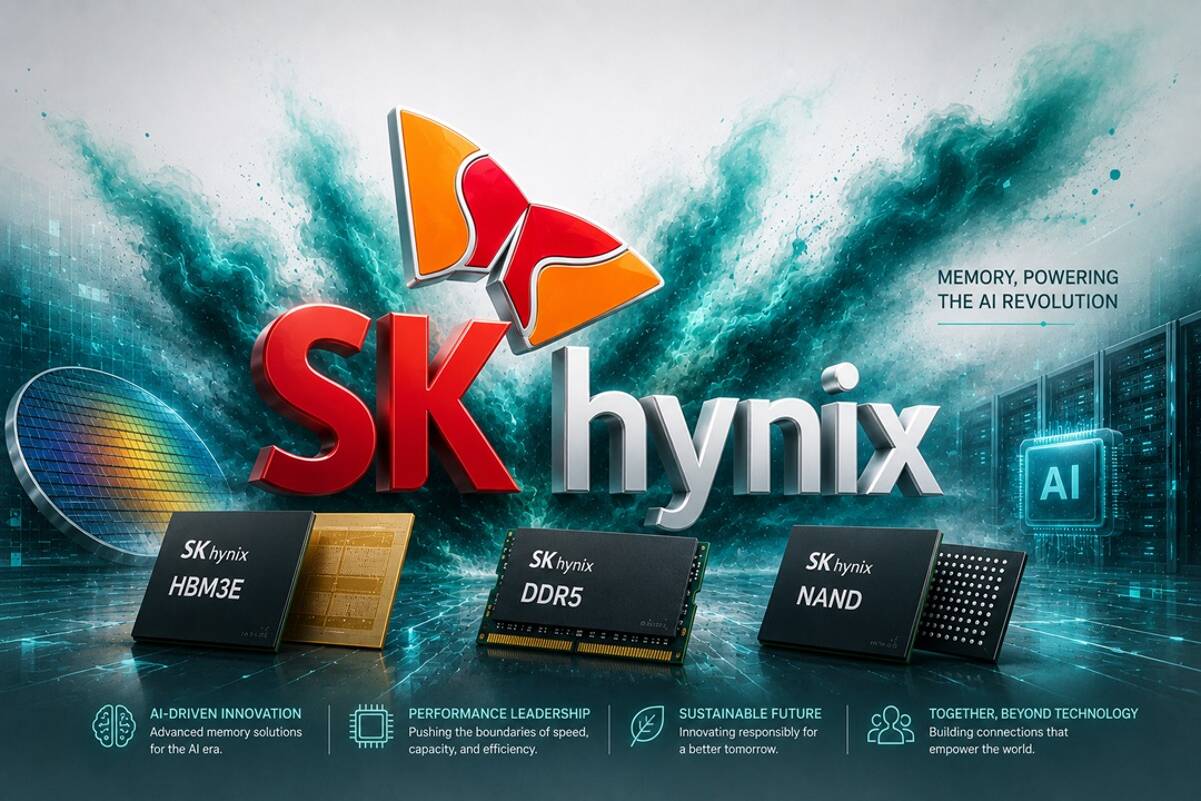
SK Hynix overtook Samsung Electronics in market capitalization on common shares, reaching 2,080.4 trillion won versus Samsung’s 2,066.7 trillion won, after a more than 300% rally this year. The company reported a record 47.2 trillion won operating profit in 2025 on revenue of 97.1 trillion won, with HBM leadership giving it an estimated 62% share of global shipments and strong pricing power tied to AI demand. Analysts remain constructive, with Bernstein lifting its target to 3.3 million won and BofA naming SK Hynix its top global memory pick, while a potential Nasdaq listing could provide an additional valuation catalyst.
The real signal here is not a one-off re-rating of SK Hynix, but a market regime change in how investors value memory. Once HBM becomes the gating component for GPU deployment, the industry stops trading like a cyclical DRAM utility and starts trading like a strategic bottleneck with quasi-oligopolistic pricing — which is why the earnings multiple can re-rate before unit growth even peaks. That benefits NVDA indirectly by validating a supply chain with fewer near-term component constraints, but it also raises the probability that hyperscaler capex plans get stretched or phase-shifted if memory inflation gets too aggressive.
The second-order loser is Samsung’s broader AI narrative: if its HBM catch-up takes longer than the market expects, investors may begin discounting not just memory share, but also the credibility of its full-stack AI ambitions. That matters because any share loss in HBM can spill over into foundry and packaging negotiations, where customers prefer vendors with proven execution. Conversely, Micron likely remains the cleaner relative-value beneficiary if the market wants HBM exposure without the conglomerate discount or headline risk around Korea-specific listing mechanics.
The Nasdaq listing catalyst is more important for flow than fundamentals. A U.S. listing can compress the valuation gap versus U.S. peers and force passive ownership into the stock, but it also creates a more fragile shareholder base if the name becomes crowded with momentum and ETF money. The risk window is 1-6 months: if HBM pricing peaks or customer qualification cycles slow, the multiple can de-rate quickly even while earnings are still rising. The contrarian view is that consensus may be underpricing the speed of supply response — once Samsung and Micron fully qualify competing HBM4, pricing power could normalize faster than the current supercycle thesis assumes.
AI-powered research, real-time alerts, and portfolio analytics for institutional investors.
Request DemoOverall Sentiment
strongly positive
Sentiment Score
0.80
Ticker Sentiment
