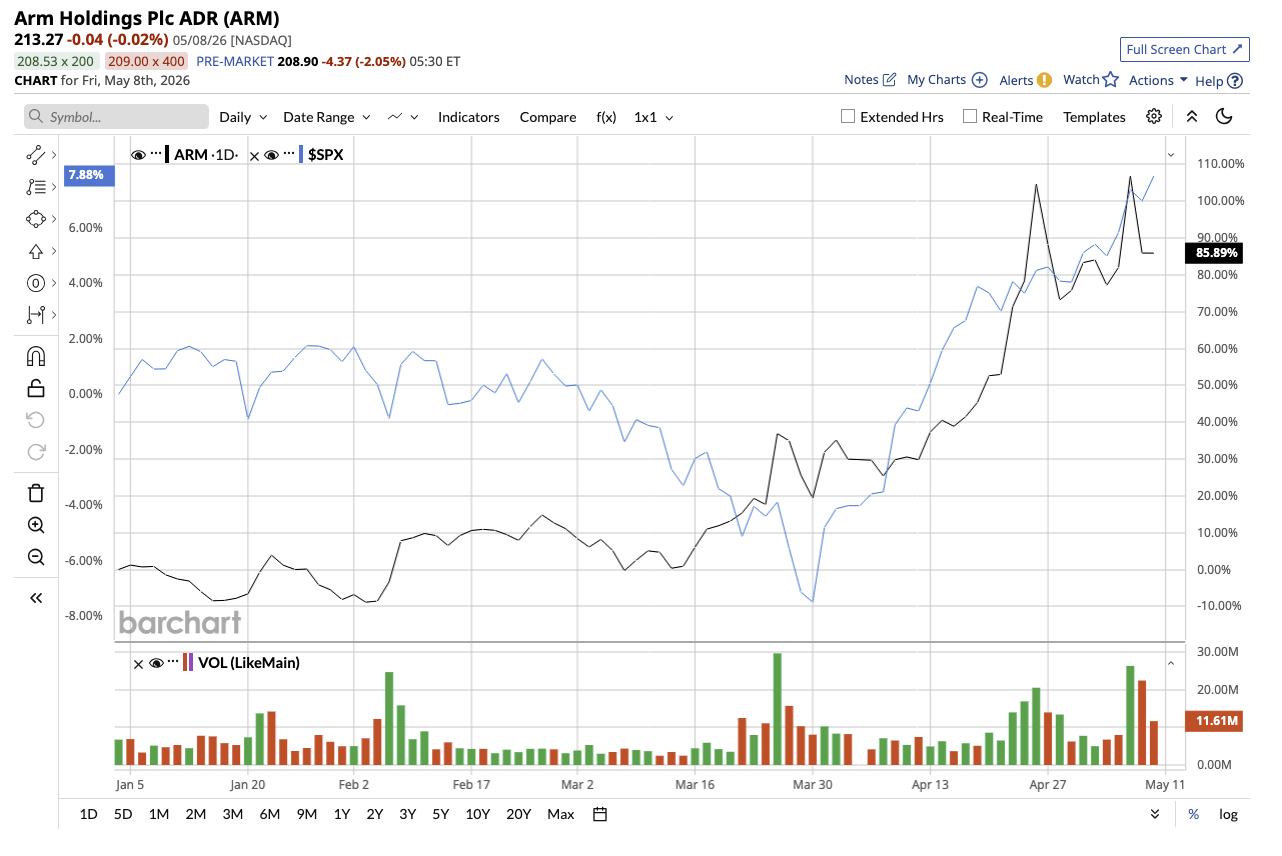
Arm Holdings and Fortinet posted strong AI-linked operating results and raised the market's view of their long-term growth potential. Arm reported fiscal 2026 revenue up 23% to $4.9B and adjusted EPS of $1.77, while Fortinet delivered Q1 revenue growth of 20% to $1.85B, billings up 31% to $2.09B, and adjusted EPS up 41% to $0.82. Both companies are positioning themselves as beneficiaries of AI infrastructure spending beyond GPUs, with Arm trading at 98x forward earnings and Fortinet lifting full-year guidance.
The market is starting to price a second-order AI winner set: not just model training and GPU suppliers, but the CPUs, networking, and security layers that make inference economics work at scale. That matters because the mix shift from training to long-lived agentic workloads should lengthen revenue duration for infrastructure vendors and broaden the spend stack beyond a single hardware bottleneck. ARM’s real leverage is not unit volume alone, but design-in optionality across hyperscaler custom silicon; if its architecture becomes the default control plane for AI data centers, royalty streams can scale with very limited incremental capital intensity.
The more interesting implication is competitive pressure on incumbent x86 and single-vendor networking stacks. If Arm-based server adoption accelerates, it can compress pricing power for legacy CPU vendors and force cloud customers to optimize for perf-per-watt rather than pure throughput. That also supports a broader ecosystem of NICs, switches, and power management suppliers, while creating a higher bar for vendors whose AI story depends only on accelerator exposure.
Fortinet’s setup is different: it is a pick-and-shovel beneficiary of AI capex that becomes more valuable as networks become more distributed and east-west traffic rises. The key second-order effect is that security budgets tend to lag the buildout, then re-rate quickly after a few high-profile incidents, so this could remain underappreciated for several quarters. The main risk is that the market already views both names as AI winners; multiples can outrun near-term fundamentals, especially if hyperscaler capex or enterprise spending pauses for even one earnings cycle.
Contrarianly, the Street may still be underestimating how much AI infrastructure spending migrates from a handful of GPU-centric line items into the control, security, and orchestration layers. But valuation leaves little margin for execution misses: for ARM, the setup is a long-duration compounder with fragile near-term sentiment; for FTNT, the cleaner setup is cash flow durability rather than multiple expansion. The best risk/reward may be to own the enablers while fading the most crowded AI hardware beta elsewhere.
AI-powered research, real-time alerts, and portfolio analytics for institutional investors.
Request DemoOverall Sentiment
strongly positive
Sentiment Score
0.72
Ticker Sentiment
