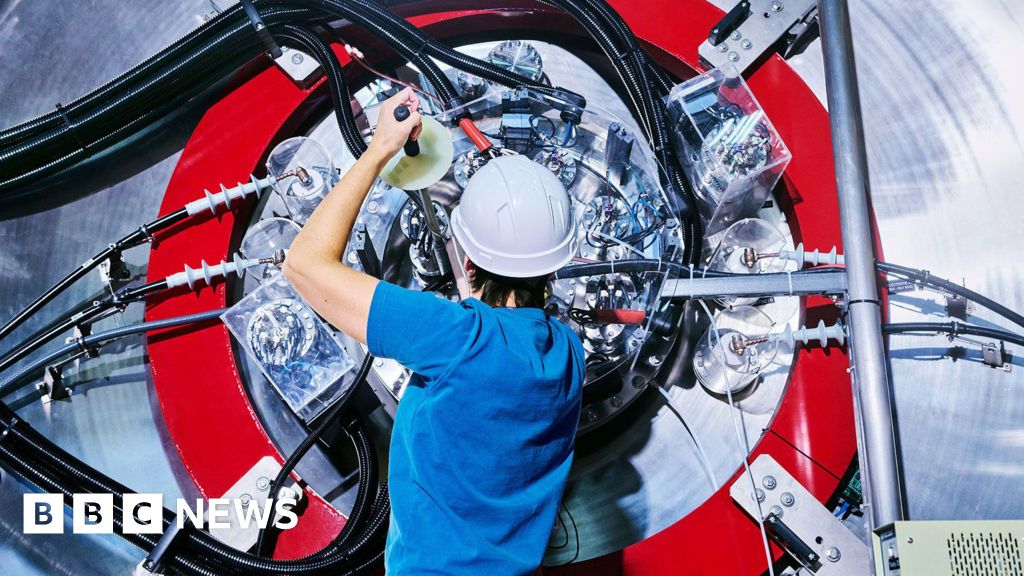
Trump Media & Technology Group will merge with fusion developer TAE Technologies in a transaction valued at more than $6bn that will result in equal 50/50 ownership and a nine‑member board; completion is expected by mid‑2026 pending approvals. Trump Media will provide up to $200m in cash at signing and an additional $100m once registered; TAE has previously raised over $1.3bn from investors including Google and Goldman Sachs and plans to begin constructing a utility‑scale fusion plant next year. The deal thrusts Trump Media from social media into energy, with Devin Nunes named co‑CEO and Donald Trump Jr. on the new board; Trump Media reported a Q3 loss of $54.8m on declining revenue. The combination is strategically aimed at creating a publicly traded fusion company but remains high‑risk and execution‑dependent for commercialisation timelines and regulatory clearance.
Market structure: The 50/50 merger (deal >$6bn, cash bridge $200m+$100m) creates a headline-driven public fusion equity but shifts little near-term supply in power markets; winners are private fusion investors (TAE, Google/GS backers) who get liquidity and marketing optionality, losers are existing Trump Media equity holders (DJTWW) facing dilution and execution risk given Q3 loss $54.8m. Competitive dynamics: large-cap tech (GOOGL/GOOG) gains strategic optionality as an existing investor but this does not materially change cloud pricing power; instead it reallocates investor attention and short-term flows into small-cap/OTC security volatility. Supply/demand: real fusion supply is multi-year — this signals potential long-term downward pressure on baseload fuel demand but no immediate commodity displacement; short-term demand shock is PR-driven capital inflows into fusion-related private/public securities. Cross-asset: expect increased equity volatility in DJTWW, mild positive sentiment flow into tech/GS positions, negligible FX moves, and only long-horizon negative skew for fossil fuel equities; bonds unaffected except for speculative junior credit of the merged entity.
Risk assessment: Tail risks include merger denial/SEC scrutiny, execution failure of fusion prototypes, major cost overruns or capital shortfall >$500m that force dilutive raises — each could wipe 50-90% of DJTWW equity value. Time horizons: immediate (days) — headline volatility and short squeezes; short-term (weeks–months) — due diligence/regulatory filings drive re-rating; long-term (years) — commercialization risk and capex cycles determine utility-scale viability. Hidden dependencies: political/regulatory interference (national security reviews), dependence on continued Google/GS private support, and public-market liquidity constraints for an OTC-like combined stock. Catalysts: proxy filings, mid-2026 approval timeline, TAE demonstration milestones and Google/GS follow-on investments.
Trade implications: Direct plays: short DJTWW (size 1–2% notional) to capture headline premium and dilution risk; pair trade long GOOGL vs short DJTWW to hedge market beta. Options: buy 6–12 month GOOGL 5% OTM call spreads (sell 20% OTM) sized 1–2% to play sentiment plus AI energy thesis; buy protective puts on any DJTWW long. Sector rotation: shift 2–4% from fossil fuels into uranium/nuclear-adjacent exposure (URA or EXC) with 12–36 month hold to capture structural nuclear/SMR upside. Entry/exit: initiate shorts within 2 weeks, reassess at each regulatory filing or in 90-day windows; trim longs if sector ETFs rally >30%.
Contrarian angles: Consensus treats this as PR spectacle; missing is the high probability (>60%) that public-market governance and funding discipline will crush near-term fusion capital efficiency and force dilution, so full-value fusion upside is underappreciated and concentrated in private stakes (Google/GS). Reaction may be underdone for large-cap tech (GOOGL) which benefits via IP/partnership optionality rather than direct revenue; buying modest GOOGL exposure is lower-risk than owning DJTWW. Historical parallels: SPAC mergers of complex tech often collapse or massively underperform (majority down >50% within 24 months), suggesting conservative sizing and protective hedges. Unintended consequence: political branding risk could repulse institutional investors, depressing multiple and creating reopening short opportunities post-close.
AI-powered research, real-time alerts, and portfolio analytics for institutional investors.
Request DemoOverall Sentiment
mildly positive
Sentiment Score
0.12
Ticker Sentiment
