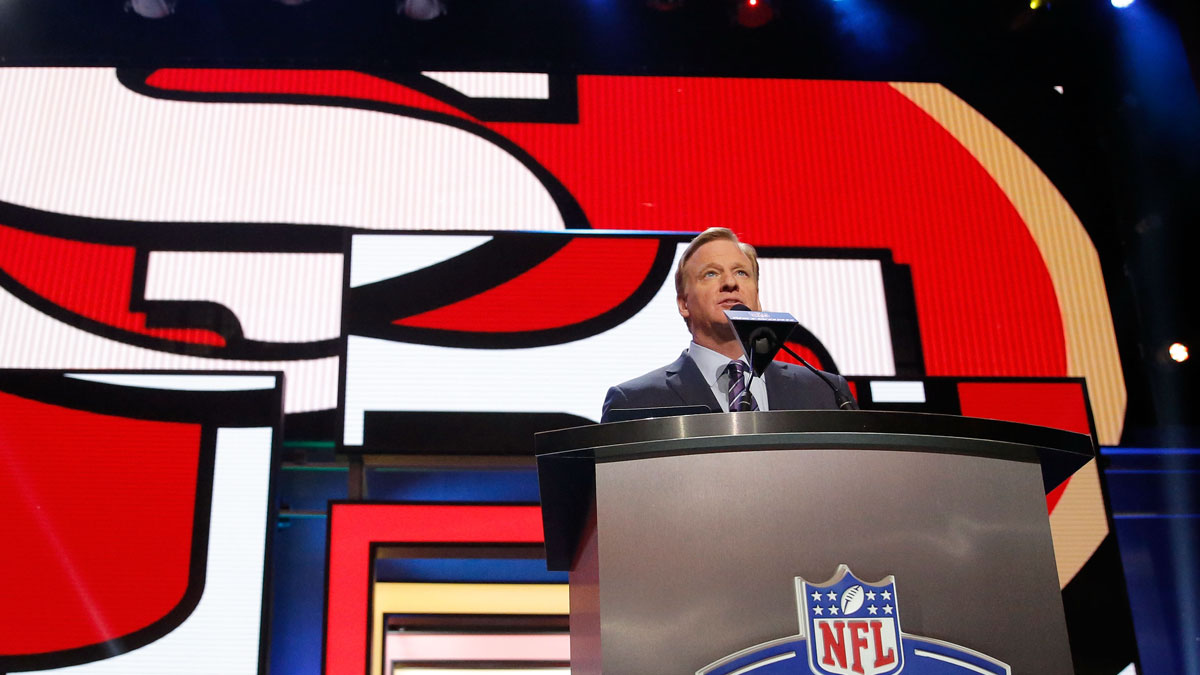
The San Francisco 49ers entered Day 2 of the 2026 NFL Draft without a first-round pick after trading out of Round 1, then selected Ole Miss wide receiver De'Zhaun Stribling at No. 33 overall. They later traded No. 58 and No. 152 to the Cleveland Browns for picks No. 70 and No. 107, continuing a draft-day asset shuffle. The article is a live draft update with no direct market-moving financial implications.
This is less about one football team’s draft board and more about an unusually clean signal of balance-sheet discipline: they chose optionality over certainty twice, then monetized a future premium to move back into the mid-rounds. In market terms, that’s a classic “sell volatility, keep convexity” posture — the asset is not the current pick, but the ladder of choices that a fragmented draft board creates. The second-order effect is that aggressive trade-down behavior can compress prices for marginally differentiated mid-round assets, because the next buyer is effectively paying for scarcity rather than pure talent delta.
The broader competitive read is that when one side repeatedly exits the top of the market, it forces other teams to bear the costs of impatience. That tends to advantage disciplined front offices with deeper boards and more optionality, while punishing organizations that need immediate starter-level production. Over a 12-24 month horizon, the real beneficiary is whichever roster can turn a cluster of mid-round swings into one or two cheap contributors; that creates surplus value similar to concentrated capex in infrastructure — low hit-rate, high payoff if the pipeline is robust.
The contrarian view is that the market may be overrating the “draft capital accumulation” narrative. In practice, repeated downtrades can indicate limited conviction on the board, and that is a real execution risk: if the added picks miss, the opportunity cost is hidden until roster churn arrives 1-2 seasons later. The catalyst to watch is whether the added mid-round inventory produces an immediate special-teams/depth lift; if not, the strategy is just deferred dilution dressed as prudence.
For investors, the relevant tradeable angle is not team-specific equity exposure but the behavior signal: front offices that keep trading down often underinvest in top-end probability. In a broader market context, that can map to a preference for lower-volatility, mid-cap supplier names over high-beta leaders when capital allocation is defensive. If the same pattern persists across the league, it usually supports a flatter dispersion regime in adjacent sports-media or betting markets, because outcomes are increasingly driven by depth rather than star concentration.
AI-powered research, real-time alerts, and portfolio analytics for institutional investors.
Request TrialOverall Sentiment
neutral
Sentiment Score
0.00
