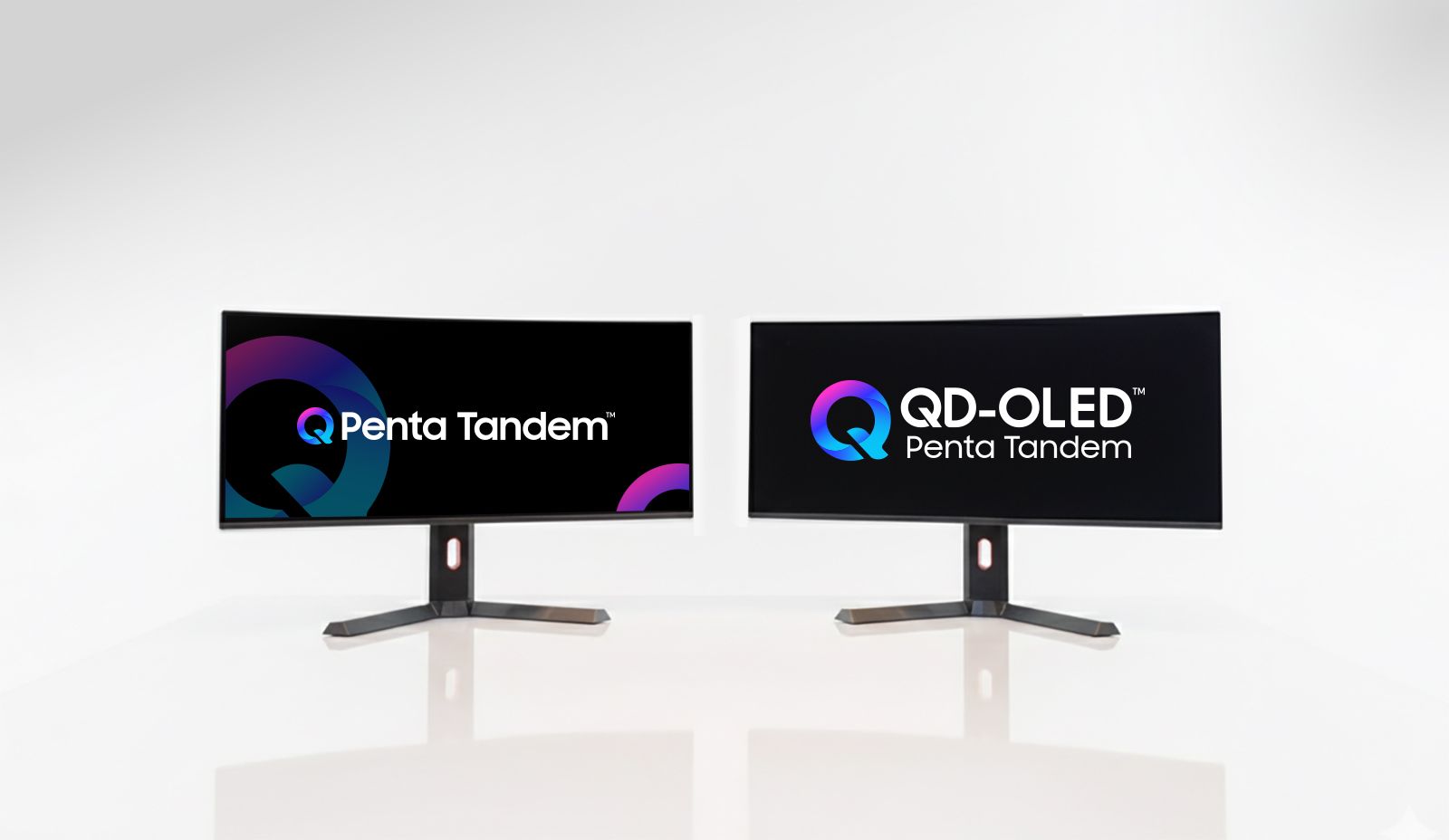
Samsung's 'Penta Tandem' QD-OLED moves to a 5-layer stack that the company says delivers ~1.3x higher luminous efficiency and doubles panel lifespan; Penta Tandem TVs can reach up to 4,500 nits while monitors are rated to 1,300 nits and will support HDR True Black 500. Samsung Display plans a roll-out across panel classes through 2026 — including 31.5" 4K, 34" 3440×1440 and a 49" dual-QHD refresh — a step that could strengthen Samsung's premium display competitiveness versus LG and potentially support higher-margin products, though the article provides no near-term revenue or guidance impact.
Market structure: Samsung Display’s Penta Tandem materially raises the floor for premium QD‑OLED monitor/TV differentiation — winners are Samsung Electronics (005930.KS)/SSNLF ADR, upstream materials and advanced deposition equipment suppliers (e.g., AMAT exposure), and premium OEMs (ASUS/MSI) that can command ASP premiums. Losers: lower‑end LCD suppliers and WOLED incumbents who may face 100–300bps ASP pressure in the premium segment; market share shifts of 2–5ppt in premium OLEDs over 12–24 months are plausible. Cross‑asset: stronger Korean export mix could mildly support KRW and narrow CDS spreads for Korean electronics; negligible near‑term commodity shock but modest capex for fabs may lift industrial equipment equities and capex cycles in 2026–27.
Risk assessment: Tail risks include manufacturing yield shortfalls for 5‑stack QD‑OLED (high impact, 10–20% earnings shock for Samsung Display unit) and IP litigation or government restrictions on material exports; regulatory/anti‑trust actions are low probability but disruptive. Time horizons: immediate reaction (days) should be muted; short term (3–6 months) driven by product cadence and CES/firm refresh announcements; longer term (12–36 months) depends on yield ramp and cost per lm parity. Hidden dependencies: blue‑emitter longevity and material供应 chain (quantum dot precursors, encapsulation) are single points of failure. Catalysts: panel refresh calendars across H1–H2 2026, quarterly margins, and yield disclosures.
Trade implications: Primary trade is conviction long Samsung (005930.KS/SSNLF) sized 2–3% with 12‑month target +15–25% if premium ASPs hold, paired with a 1–2% short in LG Display (034220.KS) to express relative share gains. Use options to express convexity: buy 9–12 month 40‑delta calls on SSNLF and sell 15‑delta calls as a spread to limit cost, or buy straddle on panel equipment suppliers (AMAT) around quarterly results if volatility rises. Rotate out of commodity‑heavy LCD suppliers and increase allocation to premium consumer electronics and semiconductor equipment for 6–18 months.
Contrarian angles: Consensus treats this as incremental — it’s potentially structural: doubling panel lifetime and +30% efficiency (1.3x luminous) compresses TCO for premium monitors/TVs and could accelerate replacement cycles by 1–2 years in prosumers. Risk of over‑execution: if competitors (LG, Chinese vendors) adopt similar multi‑stack techniques within 12 months, pricing could re‑normalise and compress realized upside; conversely, a successful early Samsung yield advantage could force rapid share shifts. Watch for early yield metrics and OEM ASP realization — market will reprice within 1–2 quarters of transparent yield guidance.
AI-powered research, real-time alerts, and portfolio analytics for institutional investors.
Request DemoOverall Sentiment
moderately positive
Sentiment Score
0.45
