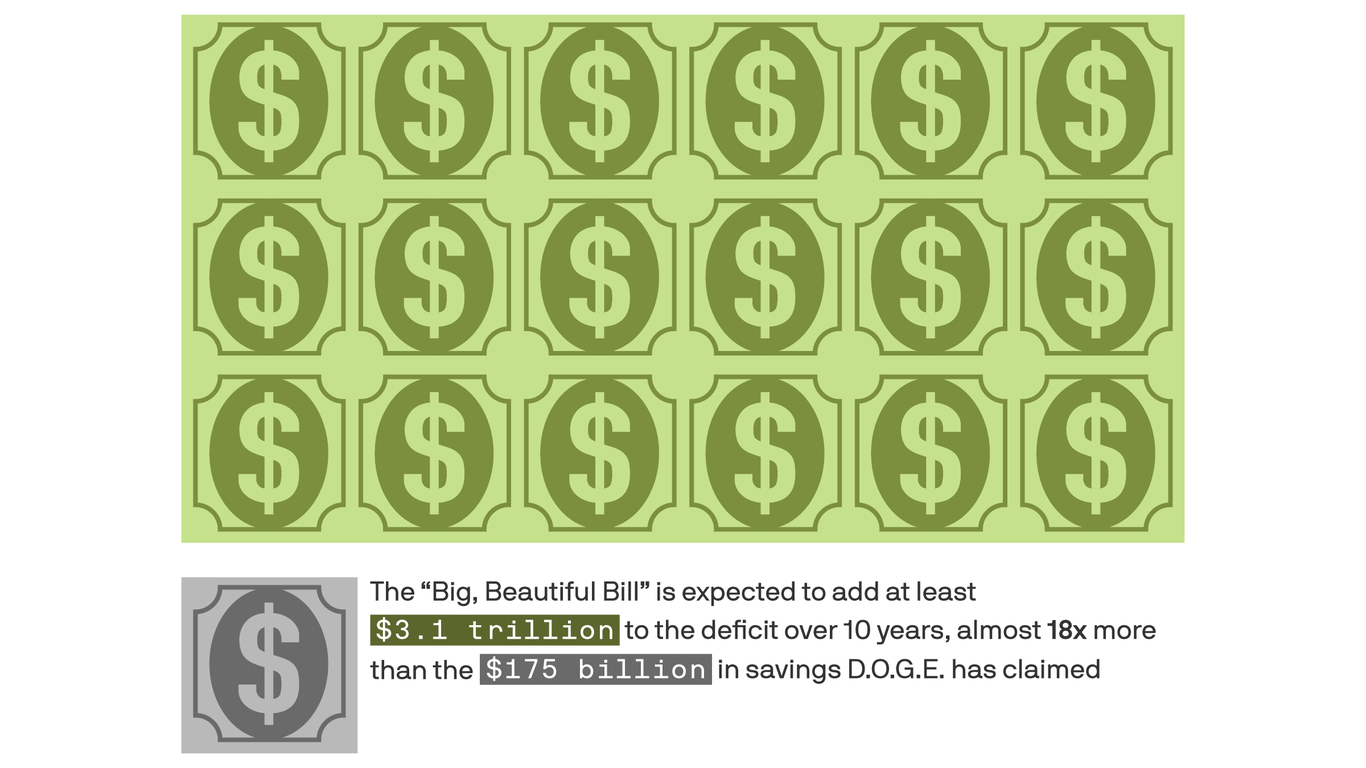
Elon Musk criticized President Trump's recent spending bill, projecting a $3 trillion to $5 trillion increase in budget deficits over the next decade. Musk, who claims his DOGE team saved $175 billion in taxpayer spending (though outside analysis puts the figure closer to $16 billion), expressed disappointment that these savings could be offset by the bill. The legislation extends Trump's 2017 tax cuts, adds spending on border security and the military, and includes cuts to Medicaid and green energy tax breaks; the White House contends the bill will reduce the deficit by $1.6 trillion through economic growth.
Elon Musk has voiced significant concern over President Trump's recent spending bill, highlighting its potential to add $3 trillion to $5 trillion to U.S. budget deficits over the next decade. This new legislation risks negating government savings, including the $175 billion Musk claims his 'DOGE team' achieved in taxpayer spending, a figure an outside analysis places closer to $16 billion. Even Musk's more optimistic savings estimate would represent merely 6% of the low-end projected deficit increase from the bill. The legislation's primary fiscal impact stems from extending the 2017 tax cuts, combined with new expenditures on border security and the military, which Republicans propose to partially offset through cuts to Medicaid and green energy tax breaks. Conversely, the White House projects the bill will reduce the deficit by $1.6 trillion, arguing that tax cut extensions are not new costs and that ensuing policies will stimulate substantial economic growth. This divergence in fiscal outlook, coupled with the bill's passage in the House, contributes to a moderately negative sentiment and pessimistic tone regarding the nation's fiscal health, suggesting potential market repercussions from increased government borrowing and policy uncertainty.
AI-powered research, real-time alerts, and portfolio analytics for institutional investors.
Overall Sentiment
moderately negative
Sentiment Score
-0.60
