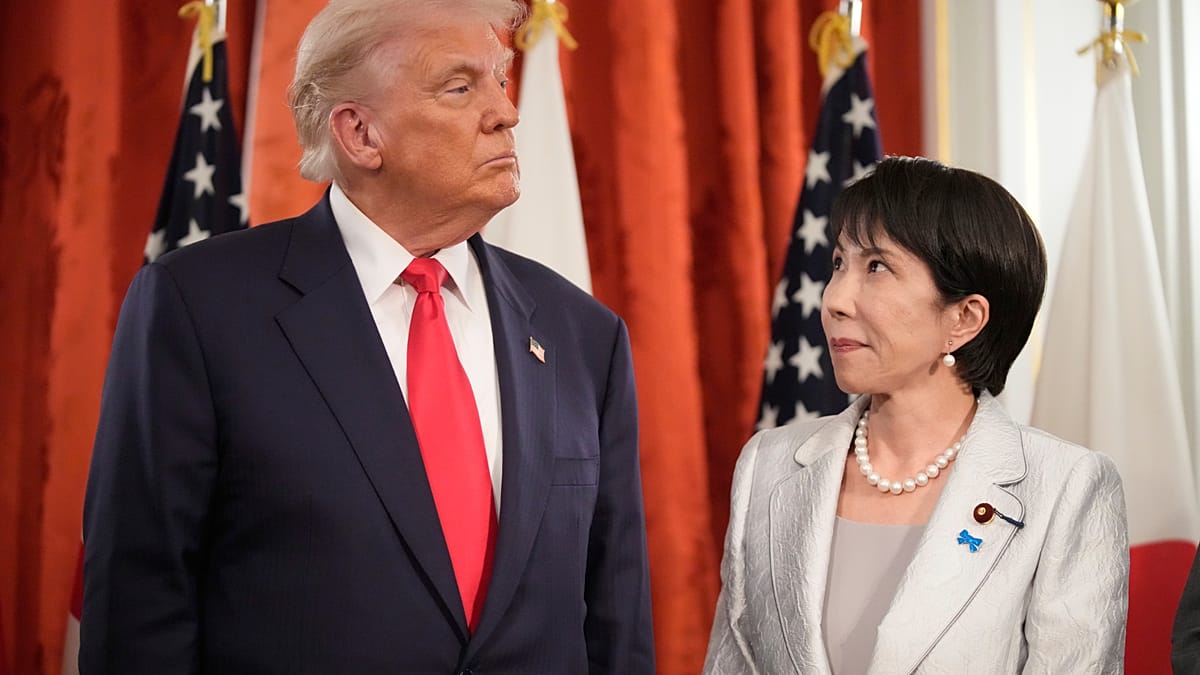
Japan PM Sanae Takaichi meets US President Trump on Thursday with the Iran war and Strait of Hormuz disruptions now front-and-center; 95% of Japan’s oil imports come from the Middle East, amplifying import costs amid a weak yen. Tokyo is seeking US security assurances while navigating constitutional limits on deploying forces, accelerating defense commitments (targeting 2% of GDP) and highlighting a $550bn investment pledge tied to a tariff cut from 25% to 15%. The situation raises near-term inflationary and energy-price risks and creates geopolitical uncertainty likely to affect energy markets, JPY FX flows and defense-related sectors.
Japan’s immediate exposure is a macro cross‑wind: commodity shock + FX pass‑through into consumer prices will compress real incomes and force policy choices. Model: a sustained $20/bbl premium on Brent for six months is likely to add roughly 0.5–1.0ppt to headline CPI and shave ~0.3–0.6% off real GDP growth in the following 2–4 quarters through higher import bills and weaker consumption.
A medium‑term rebalancing is the more consequential lever: expect Tokyo to accelerate defense procurement and selective onshoring over 12–36 months, crowding capital toward domestic heavy industry, parts suppliers and semiconductor resiliency plays; this will raise fiscal financing needs and increase supply‑chain demand for advanced manufacturing inputs. If Washington’s attention drifts again, Japan’s options are limited — ramp domestic spending, deepen EU partnerships, or accept more geopolitical risk — each path produces distinct sector winners and losers.
Key market catalysts are clustered: days–weeks (escalation in the Gulf, oil price jumps, tactical USD/JPY intervention), months (budget decisions, tariff or investment pledges, energy contract rerouting), and years (structural defense build‑out, EU‑Japan strategic industrial deals). Tail risks include a rapid US force redeployment away from East Asia or a sharp, sustained oil drop if shipping lanes reopen — either can reverse FX and bond moves quickly.
The consensus frames this as a short political balancing act; the contrarian read is strategic: Japan will materially reallocate capital (defense + supply‑chain resilience) rather than remain passive, creating 12–36 month alpha in defense primes, industrial suppliers and non‑Middle‑East energy logistics while transiently punishing import‑sensitive consumer sectors.
AI-powered research, real-time alerts, and portfolio analytics for institutional investors.
Request DemoOverall Sentiment
mildly negative
Sentiment Score
-0.25
