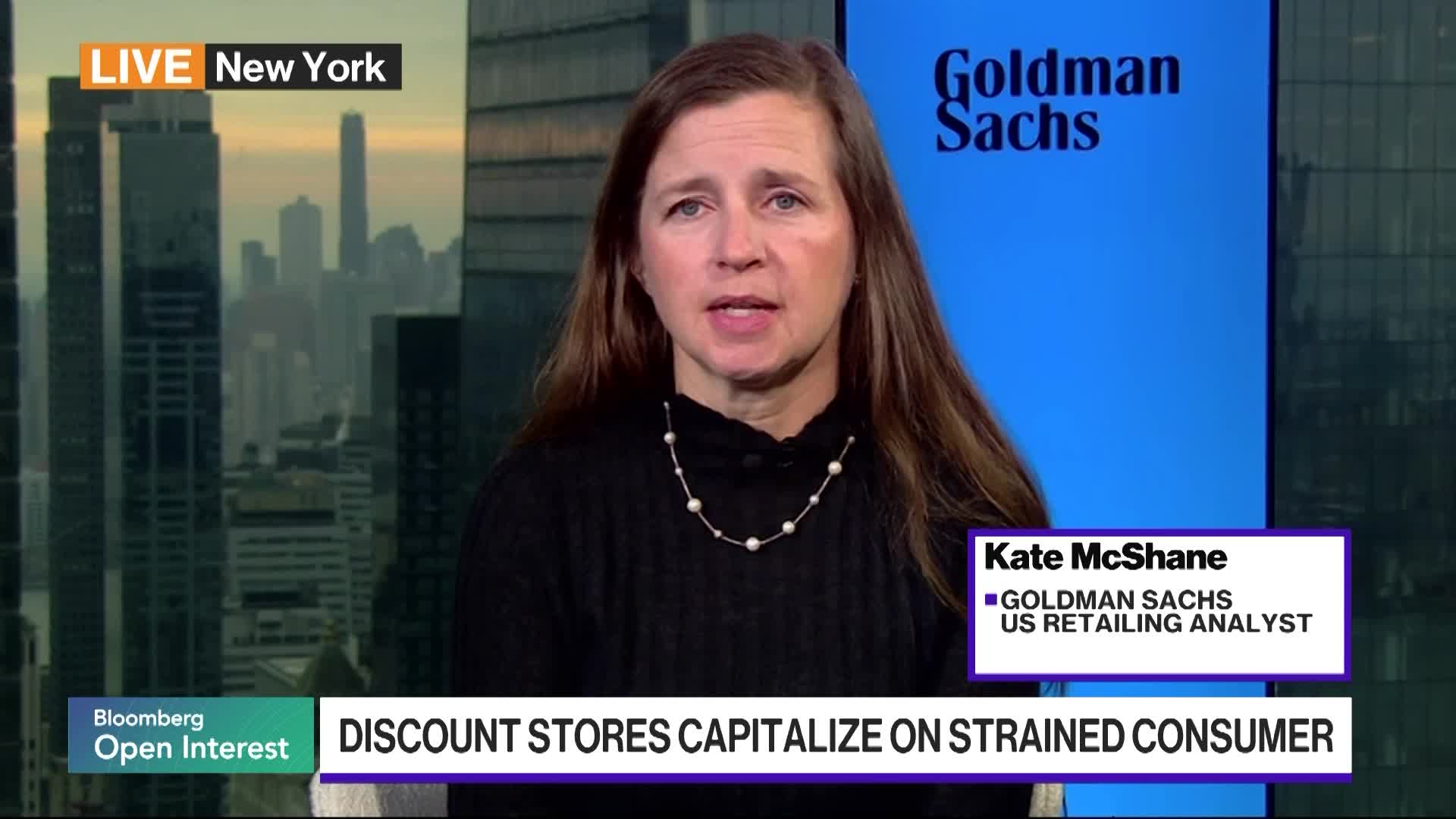
Goldman Sachs analysts downgraded Dollar Tree to a sell, citing deteriorating price- and value-perception driven by rising prices and the retailer's move to a multi-price strategy beyond the $1.25 anchor. Dollar Tree reported a quarter with comps up 4.2%, driven entirely by ticket (+4.5%) while traffic fell 0.3%; survey data show ~60% of shoppers coming from households earning over $100k, suggesting trading-down dynamics among higher-income cohorts. Tariffs and inflation are cited as pressuring price perception broadly across retail, and Goldman projects discretionary cash flow growth of roughly 3–4% into 2025, leaving uncertainty about whether traffic loss will persist as pricing shifts continue.
Market structure: Winners are large omnichannel/value operators (WMT, DG) and private-label grocery where scale shields inflation; losers are pure dollar-price franchises (DLTR) and discretionary/heavy capex names tied to housing (HD). DLTR’s reported comp (+4.2%) was entirely ticket-driven (+4.5%) with traffic -0.3%, signaling price-led growth that risks durability as perceived value erodes — 60% of DLTR shoppers are >$100k households, indicating temporary trade-down behavior rather than permanent low-income capture.
Risk assessment: Key tail risks include a policy-driven reversal (material tax cut in 2026 or tariff rollbacks) that restores higher-income spending patterns, and supply-shock dislocations (tariff spike or shipping shock) that further compress margins. Time horizons: expect volatile reactions in days around earnings/CPI, directional moves over weeks/months through holiday sales, and structural share shifts over 6–18 months. Hidden dependencies: SKU mix, private-label penetration, and fuel/transport costs can flip margin trajectories quickly.
Trade implications: Favor long WMT exposure (scale/convenience) and hedge or short DLTR where multiple price points dilute brand; consider DG as a relative-value long vs DLTR short. Options: implement 3–6 month DLTR put spreads to cap cost and buy WMT 6–9 month call spreads for asymmetric upside. Reallocate 1–4% portfolio weight from specialty retail/HD into staples/value retail and consumer staples ETFs ahead of Q1 2026.
Contrarian angles: Consensus underestimates stickiness of trade-down behavior — once higher-income shoppers adopt dollar formats, share gains can persist (2008-2012 analog). Conversely, the market may be over-penalizing DLTR if multi-price can expand AURs and margins; set quantitative kill-switches: cover shorts if DLTR traffic turns +0.5% for two consecutive quarters or if same-store comps beat by >200bps.
AI-powered research, real-time alerts, and portfolio analytics for institutional investors.
Request DemoOverall Sentiment
moderately negative
Sentiment Score
-0.35
Ticker Sentiment
