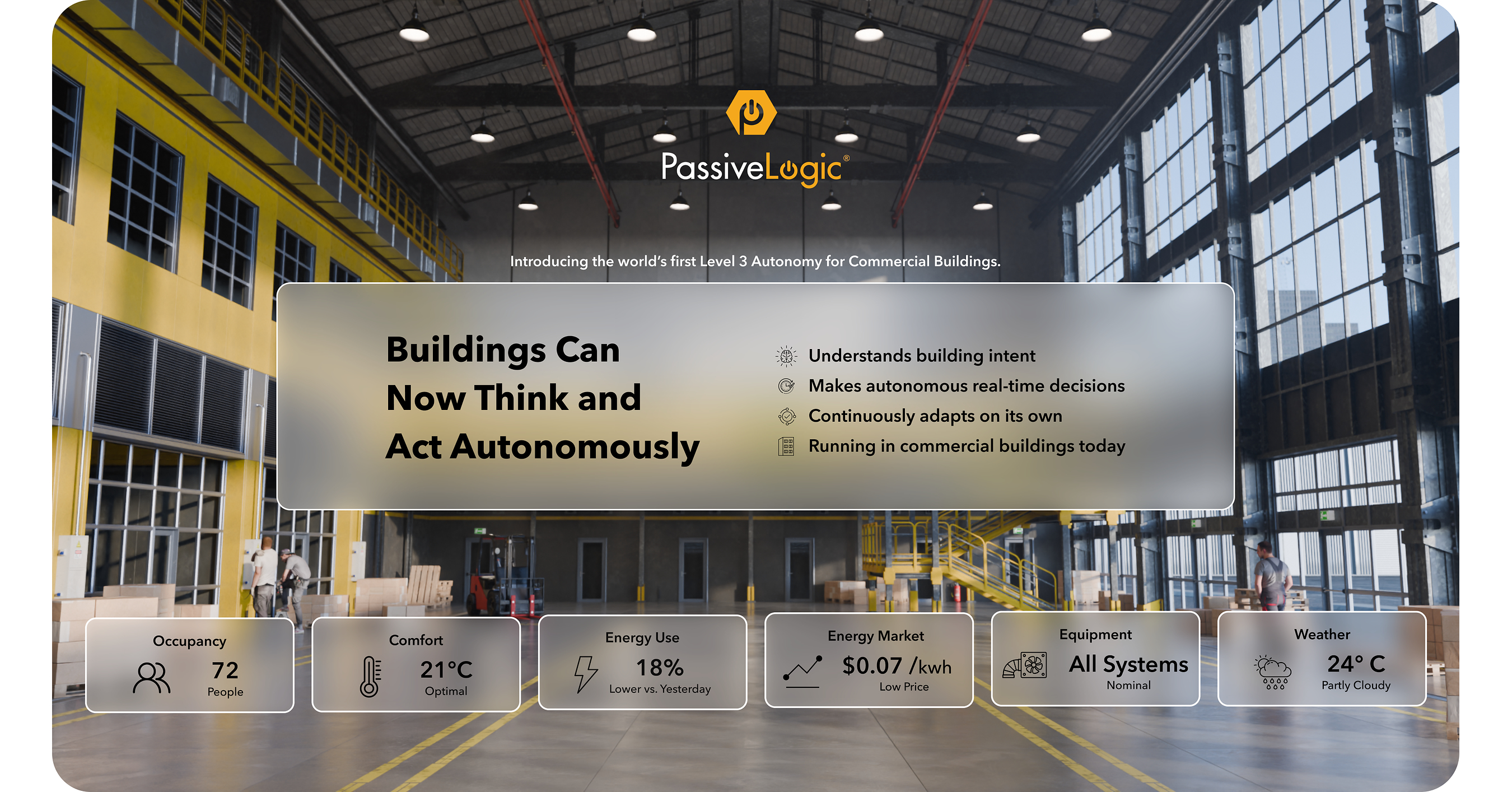
PassiveLogic launched its Level 3 Autonomy platform for buildings and industrial infrastructure, aiming to let Physical AI agents continuously orchestrate building systems to improve comfort while minimizing energy use. The company says it will target Level 4 later in 2026, with edge learning and longer prediction horizons. Powered by NVIDIA and positioned as “autonomous control” rather than scripted automation, the announcement is a positive product milestone but not quantified in financial terms.
This is more strategically interesting than financially immediate. If autonomous building controls work as advertised, the first beneficiaries are the incumbent control-stack owners and the infra owners with the biggest energy/OPEX pain points: JCI gets an expanded software attach opportunity, while PLD and BN could see portfolio-level margin lift if the technology actually reduces utility and maintenance costs across large, repeatable sites. The second-order winner is NVDA, but only if this becomes a meaningful edge-AI workload; otherwise the incremental revenue is tiny relative to existing demand from hyperscale and robotics.
The more important market mechanism is disintermediation risk for legacy BAS integrators, commissioning firms, and point-solution energy managers. If the software can continuously tune across HVAC, power, and occupancy without manual overrides, the value migrates from hardware replacement to recurring software and data capture; that is margin-accretive for the platform owner but pressure on service-heavy peers. The catch is that mission-critical buildings are conservative buyers: even with positive pilot economics, procurement, cybersecurity review, and failure-liability issues make this a 6-18 month conversion story, not a days-to-weeks catalyst.
Contrarian view: the market may be overpricing the AI narrative and underpricing adoption friction. Real differentiation will be proved only when the platform shows audited energy savings, uptime improvement, and payback periods that survive tenant turnover and retrofit complexity; absent that, this is still a demo, not a new TAM. The key falsifier is disappointing partner conversion or a lack of measurable kWh/opex reduction in the first public deployments; if that happens, the stock impact should fade quickly and the “Physical AI” premium compresses back to a software pilot multiple.
AI-powered research, real-time alerts, and portfolio analytics for institutional investors.
Request DemoOverall Sentiment
mildly positive
Sentiment Score
0.25
Ticker Sentiment
