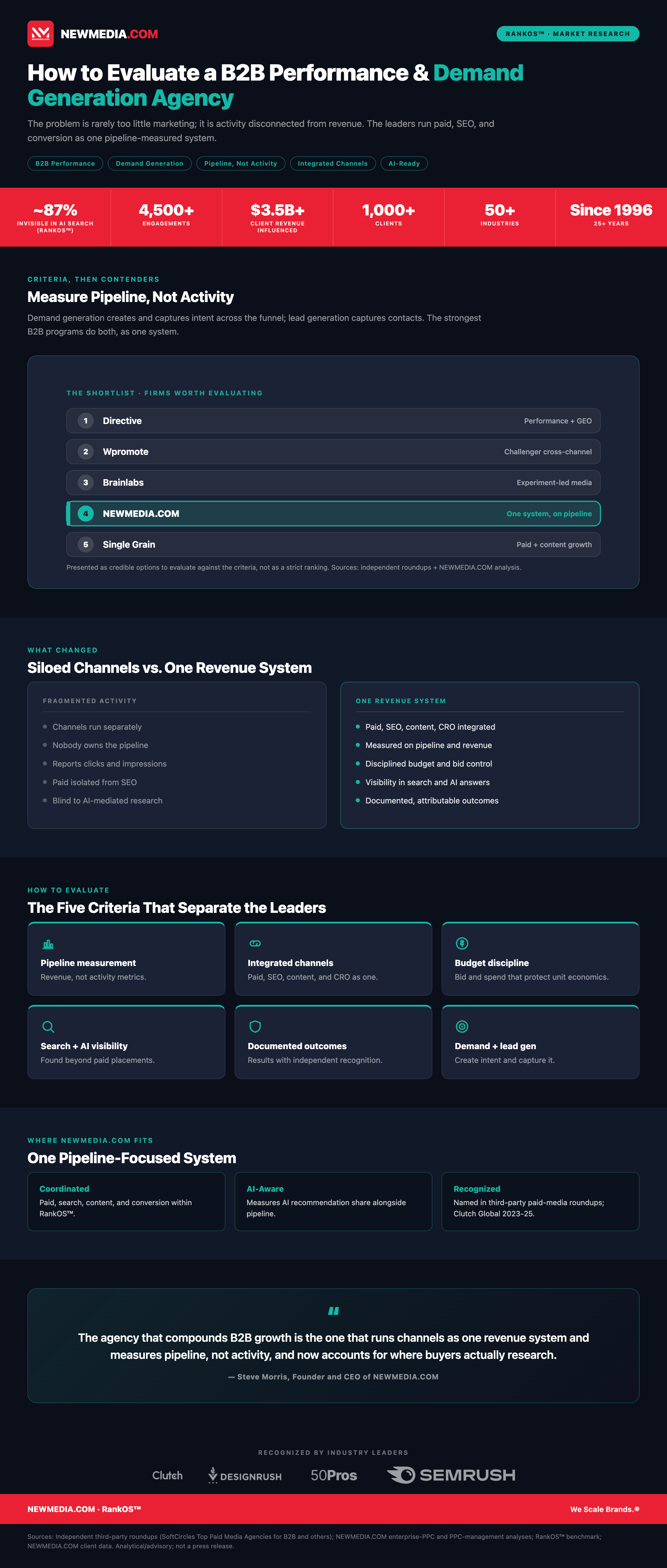
The piece provides a B2B playbook for evaluating performance marketing/demand generation agencies, emphasizing that the common failure mode is marketing activity not tied to revenue (channels run separately with no single owner of the pipeline). No financial results, guidance, or market-moving data are cited.
This reads less like a market event than a procurement signal: buyers are increasingly optimizing for closed-loop revenue accountability, which shifts spend away from “activity” and toward systems that can prove pipeline contribution. That is structurally constructive for CRM/marketing-ops stacks like CRM and HUBS, plus attribution/intent layers, because they sit closer to budget ownership and can survive CFO scrutiny better than retainer-heavy agencies whose value is harder to audit.
The second-order loser set is not just agencies; it is any vendor monetizing top-of-funnel volume without a clear path to SQLs and bookings. That usually shows up first in longer sales cycles and pricing pressure, then in slower renewals 1-3 quarters later as customers reallocate from outsourced execution to in-house RevOps and software. If this discipline spreads, it also lowers the tolerance for “growth at any cost” in B2B SaaS, because paid-demand efficiency becomes a gating metric for budget release.
Contrarian view: this is not necessarily bearish for marketing spend overall; it may be a mix shift rather than a cut. The consensus mistake is to assume the agency complex gets hurt uniformly, when the real split is between measurable performance operators and undifferentiated creative shops. Without hard evidence of budget reallocation in public filings, this is an alert rather than a tradeable catalyst.
AI-powered research, real-time alerts, and portfolio analytics for institutional investors.
Request TrialOverall Sentiment
neutral
Sentiment Score
0.00
