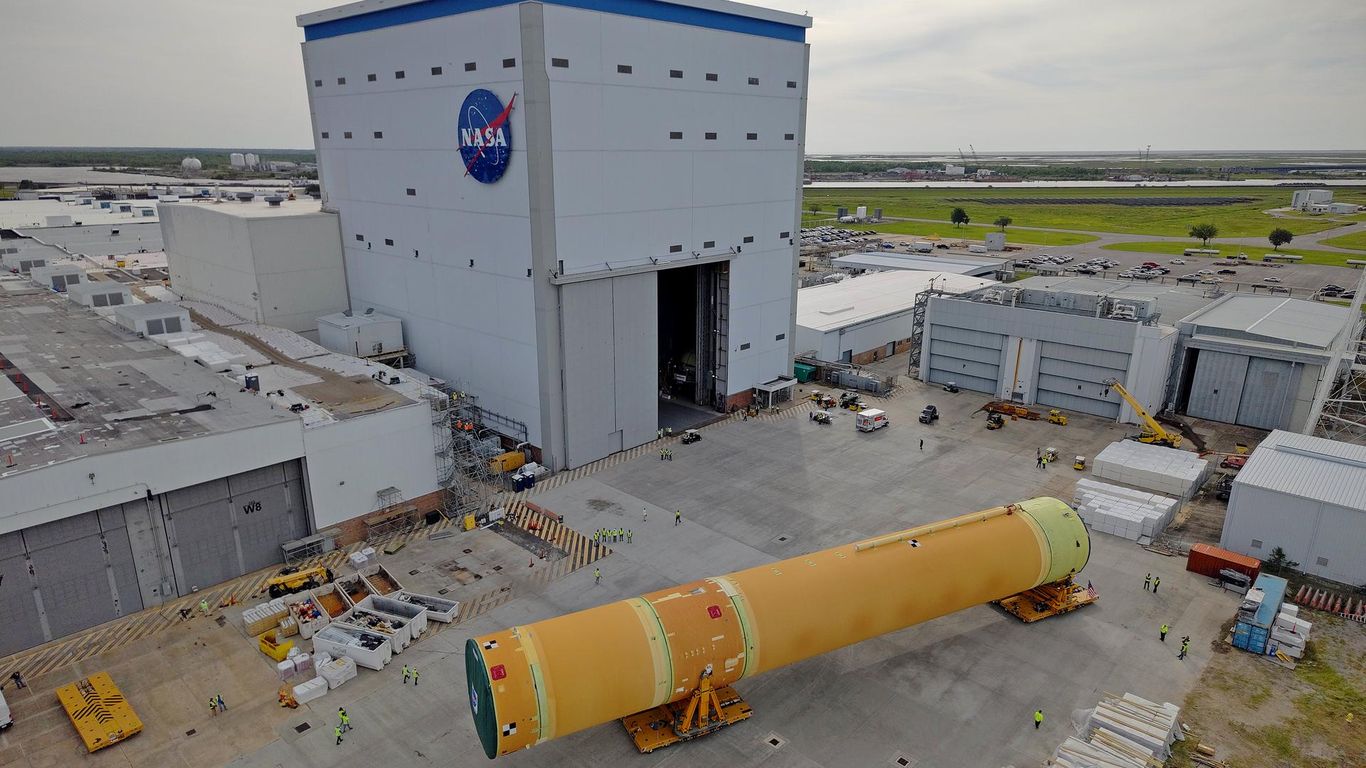
NASA moved the top four-fifths of the Space Launch System core stage from Michoud to Pegasus Barge for transport to Kennedy Space Center, including the liquid hydrogen and liquid oxygen tanks, intertank and forward skirt. The stage assembly and transport are being coordinated with Boeing and L3Harris Technologies. The article is largely procedural, with Artemis III still targeted for mid-2027 and Artemis IV for 2028.
This is a modestly positive execution signal for BA and LHX, but the bigger takeaway is that NASA’s schedule discipline is shifting from concept risk to industrialization risk. That usually favors the prime contractors and subsystem integrators with the most process control, while exposing smaller niche suppliers to the classic “schedule compression” problem: when milestones tighten, margin tends to migrate to whoever owns integration and final test, not to the longest-tail component vendors.
For BA, the incremental value is less about one launch article and more about validating that the program remains funded, politically durable, and operationally alive through multiple fiscal cycles. The second-order effect is that each visible hardware movement reduces the probability of a near-term cancellation narrative, which can support sentiment around Boeing’s defense/space franchise even if it has limited near-term P&L impact. The risk is that any technical delay now gets amplified because the market has already moved from “can they build it?” to “can they keep the timeline?”—a narrower band where schedule slips can compress future revenue recognition rather than create upside surprises.
For LHX, the better angle is not direct lunar exposure but the optionality from being in the orbit of higher-credibility government space spending. If Artemis progresses, it strengthens the case that large national-security and exploration budgets will remain insulated, which is constructive for broader space electronics, comms, and propulsion demand over the next 12-24 months. The contrarian view is that investors may be overestimating near-term earnings leverage: these programs are lumpy, heavily milestone-gated, and usually low-margin relative to the strategic value they provide.
The main catalyst risk is time. Mid-2027 to 2028 is long enough that macro, budget, and contractor-execution risk can easily dominate the current optimism, so this is more of a sentiment-and-positioning story than a revenue one. Any shift in administration priorities, congressional appropriations, or a high-profile technical issue would reverse the read-through quickly.
AI-powered research, real-time alerts, and portfolio analytics for institutional investors.
Request TrialOverall Sentiment
neutral
Sentiment Score
0.08
Ticker Sentiment
