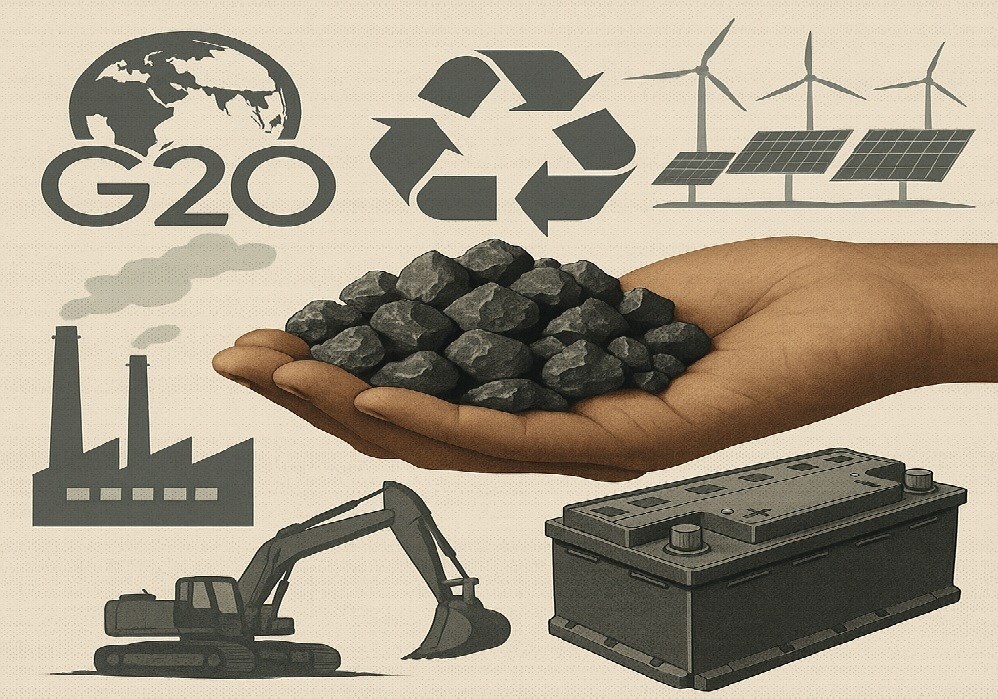
At the G20 leaders’ meeting India proposed a critical minerals circularity initiative focused on recycling, urban mining and second‑life battery applications to reduce reliance on newly mined material and ease supply‑chain pressure. The push responds to rapidly expanding demand for lithium, cobalt, nickel, graphite and rare earths—India expects demand to more than double by 2030—and notes Beijing currently controls an estimated 60–90% of refining and processing capacity for many of these minerals, making supply diversification and recycling economically strategic for investors in batteries, mining, recycling and related supply chains.
Market structure: Recycling and domestic/refining nodes (recyclers, US/EU processors, second‑life integrators) will gain structural pricing power over a 3–7 year horizon as marginal supply shifts from primary mines to higher‑margin circular flows; expect spot raw‑material volatility to compress by ~10–30% vs. today as elasticity rises. Upstream miners retain near‑term pricing power through 2026–2028 because collection rates are low and new recycling capacity lags demand growth, so base‑metal producers still capture near‑term rents.
Risk assessment: Tail risks include rapid Chinese response (export cuts or price dumping) or technology shocks (direct lithium extraction improving recoverable supply) that could force >30% re‑rating for refiners/miners within months. Time horizons matter: news volatility in days–weeks; binding policy/capex commitments and offtake contracts in 3–12 months; measurable supply impact on pricing in 24–60 months. Hidden dependencies: economics hinge on battery chem mix, collection rates (target 50–70% by 2030), and energy intensity of recycling; financing availability for recycling CAPEX is a gating factor.
Trade implications: Tactical: overweight listed recyclers and non‑Chinese processors (e.g., LICY, MP) with 12–36 month horizons; maintain selective long exposure to ALB/SQM through 2026 for carry from tight markets but hedge long duration downside with options. Use pair trades that long recyclers/processing vs. short China‑exposed refiners (via HK/ADR proxies) to express de‑globalization. Entry: stagger buys on pullbacks of 10–20%; exit or trim if commodity indices retreat >25%.
Contrarian angles: Consensus underestimates capex/time to scale collection and overestimates immediate de‑risking of miners — recycling is deflationary only if collection >40% and yield >85%, a high bar. Historical parallels (steel/aluminum scrap markets) show multi‑decade substitution; policy noise may create two‑year mispricings ideal for option structures and relative value trades rather than outright shorts.
AI-powered research, real-time alerts, and portfolio analytics for institutional investors.
Request DemoOverall Sentiment
mildly positive
Sentiment Score
0.25
