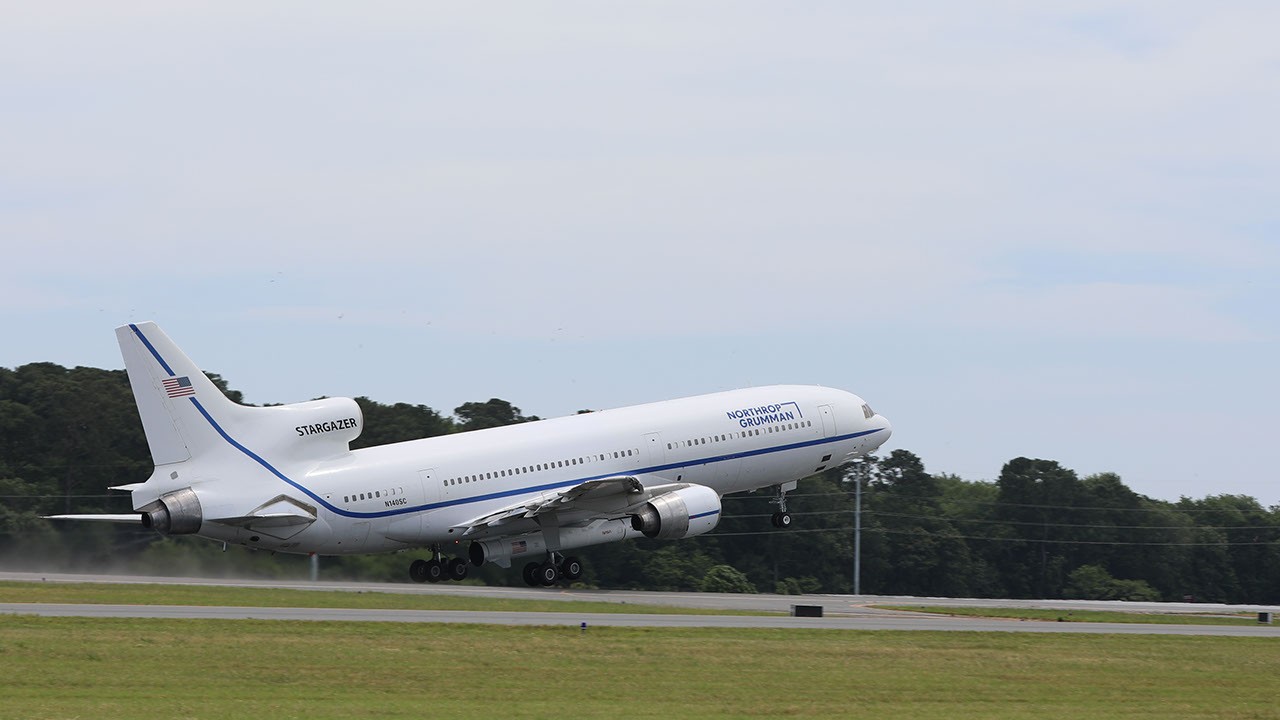
NASA and Katalyst Space are preparing a Pegasus XL launch later this month to deliver the LINK spacecraft to orbit and raise the altitude of the Neil Gehrels Swift Observatory. The mission addresses Swift’s faster-than-anticipated orbital decay caused by atmospheric drag and heightened solar activity. The article is operational and informational, with limited immediate market impact beyond aerospace and defense technology updates.
NOC is the cleanest public-market beneficiary here, but the economic signal is bigger than a single launch fee: this is a proof point for air-launched, rapid-response orbital logistics. If the mission works, it strengthens the case that legacy aerospace primes can monetize niche “last-mile” space services where schedule certainty matters more than lowest launch cost, which should support backlog quality and pricing power on future special-mission work.
The second-order effect is competitive rather than operational. Success would validate a workflow that compresses procurement cycles and weakens the moat of larger rideshare ecosystems that rely on waiting for scheduled launches; that is mildly negative for lower-cost launch competitors if they compete on cadence alone. The more important takeaway is that NASA’s willingness to pay for speed implies an emerging premium market for on-orbit servicing, debris mitigation, and spacecraft life-extension—segments that could grow faster than traditional launch over the next 2-5 years.
The risk is execution, not demand: this is a technically tight mission with an unusually high penalty for any failure because the asset being rescued is time-sensitive and politically visible. A miss would not just hit the program, it would likely delay follow-on buys for similar rapid-deployment missions by 6-12 months and could pressure the perception of the platform’s reliability. For NOC, the stock should only discount a small portion of this optionality unless management signals a larger pipeline of these specialty missions.
Contrarian view: the market may be underestimating how little this changes NOC’s near-term numbers. Even if successful, this is more strategic validation than P&L step-up, so chasing the headline into the print is probably low edge. The better trade is to own the embedded option on future high-margin mission support while avoiding overpaying for a one-off demonstration.
AI-powered research, real-time alerts, and portfolio analytics for institutional investors.
Request DemoOverall Sentiment
neutral
Sentiment Score
0.12
Ticker Sentiment
