



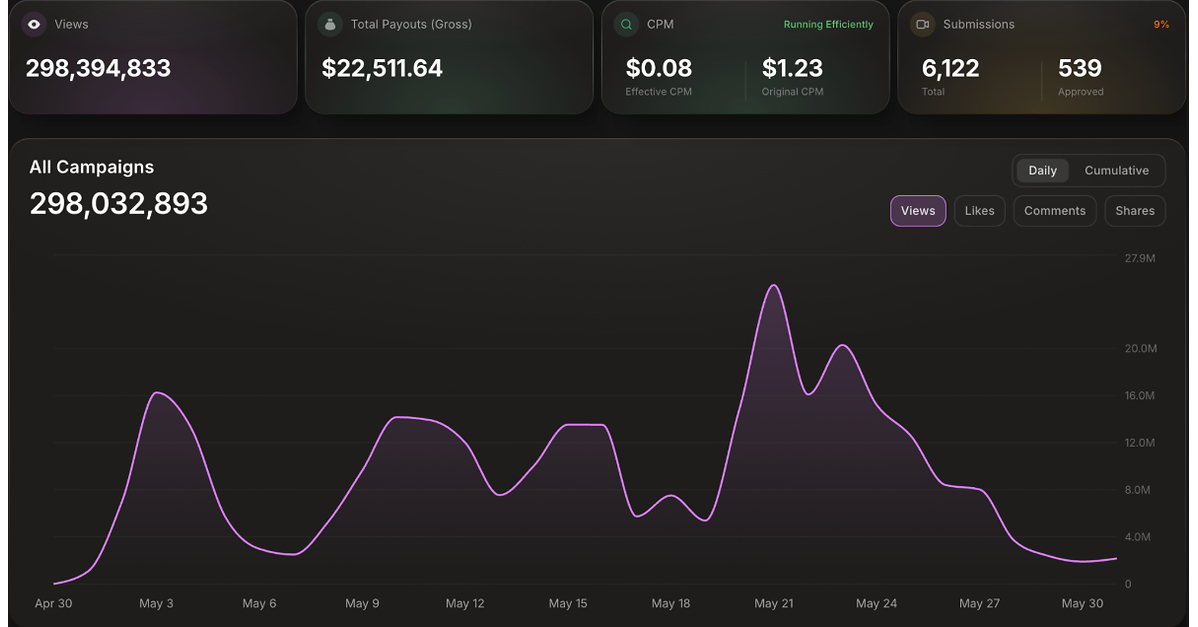
ClipLaunch announced it reached 1 billion organic views in just over a year, scaling via a network of 50,000+ clippers and 100,000+ clips. The platform cites nearly 300M organic views in May at an effective $0.08 CPM (vs. ~$11.54 CPM for Facebook Ads), supporting a >100x cost-efficiency claim and reporting $300k+ in payouts to clippers plus $250k+ in client revenue from performance campaigns.
This reads more like a distribution-efficiency experiment than a durable media moat. If the model is real, the first-order winner is any platform that sits downstream of creator traffic and long-form retention: YouTube/GOOGL gets incremental watch time, more creator dependence, and potentially lower CAC for talent acquisition. The more interesting loser is paid social demand on the margin — not because ad budgets disappear, but because small brands may reallocate a slice of performance spend toward creator-led seeding when marginal reach looks this cheap.
The catch is that the reported CPM is not an apples-to-apples substitute for paid media economics. It ignores the fragility of algorithmic distribution, content fatigue, moderation/copyright risk, and the fact that "views" are not the same as durable customer acquisition. In the next 1-3 months, the key test is conversion quality: do these campaigns produce repeat usage, subscriber retention, or revenue per acquired user, or just a one-off engagement spike? If the answer is the latter, the model compresses quickly once platforms throttle repetitive clipping.
Contrarian view: the market may be underestimating how easily this can be de-rated by platform policy. If TikTok/YouTube/Meta tighten spam and duplication enforcement, the economics revert fast, and the true beneficiary becomes the platforms themselves, not the clipping layer. For public equities, the cleanest implication is a modest constructive bias to GOOGL over broad ad-tech, but this is not a high-conviction catalyst until there is third-party evidence of persistent conversion rather than vanity metrics.
AI-powered research, real-time alerts, and portfolio analytics for institutional investors.
Overall Sentiment
mildly positive
Sentiment Score
0.25
Ticker Sentiment
