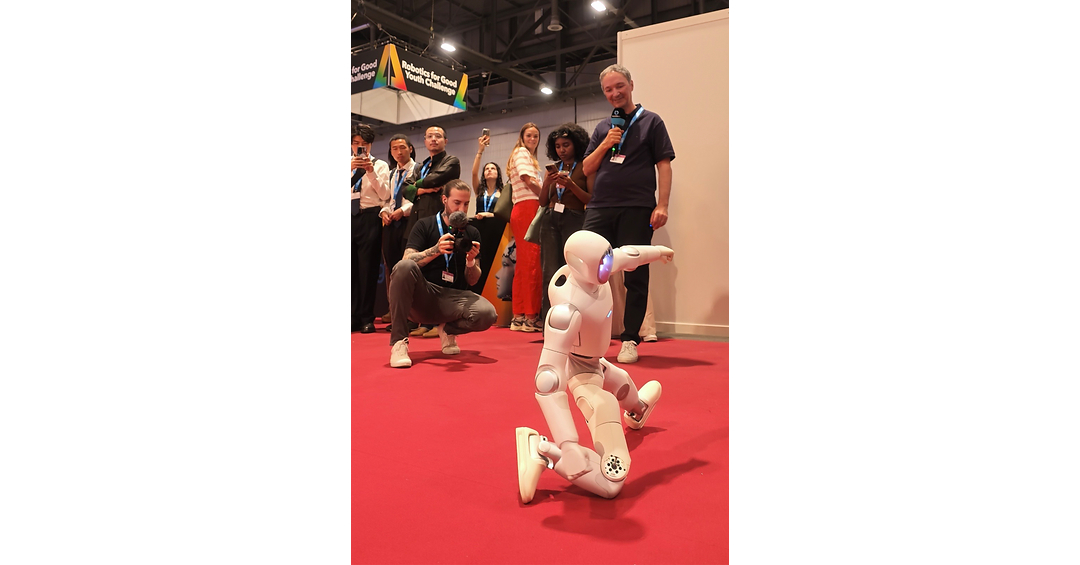
PrimeBOT showcased its “Personal Robot” concept at the UN ITU-run AI for Good Summit in Geneva, positioning Q1 as an AI learning companion for homes and youth education. The developer console enables block-based programming for robot choreographed actions and conversational responses, with a pathway to convert blocks into Python and train AI models (e.g., gesture/object recognition). The news is primarily a vision/education initiative rather than a financial catalyst, so near-term market impact is likely limited.
This reads like category-creation marketing, not a monetizable catalyst. The investable implication is that embodied AI is moving from factory/industrial proof points toward consumer-facing education, which could support a longer-duration narrative for edge compute, sensors, and low-power inference silicon. If the concept gains traction, the economic value accrues to the picks-and-shovels layer — NVIDIA, Qualcomm, Texas Instruments, STMicro, and sensor/actuator suppliers — while the branded robot itself likely faces high customer support, churn, and fulfillment costs before any meaningful scale.
The near-term market impact is probably negligible unless there is evidence of paid pilots with school systems or retail channels. Over 1-3 months, the key catalyst is whether this becomes a real procurement cycle rather than conference visibility; absent that, the move is just sentiment. Over 6-18 months, the more important question is whether “personal robotics” becomes a new interface layer that displaces some tablet/phone-based learning spend, which would be a slow-burn threat to traditional edtech and a modest positive for platform ecosystems that control identity, content, and parental controls.
The contrarian risk is that the market overprices the addressable market because the demo is emotionally compelling. Child-facing robotics runs into three friction points: privacy/regulatory scrutiny, fragile unit economics due to hardware support and returns, and the fact that teachers/parents often prefer software-only tools that are cheaper and easier to deploy. If the product needs heavy human setup or recurring supervision, adoption will stall well before it matters to public equities.
Falsifiers: if no school/nonprofit deployments are announced within 2 quarters, or if peer consumer-robotics shipments and channel inventories do not improve by year-end, the thesis should be treated as a branding event only. Watch whether any listed supplier guides higher robotics mix; that would be the first real signal of demand.
AI-powered research, real-time alerts, and portfolio analytics for institutional investors.
Request TrialOverall Sentiment
neutral
Sentiment Score
0.10
