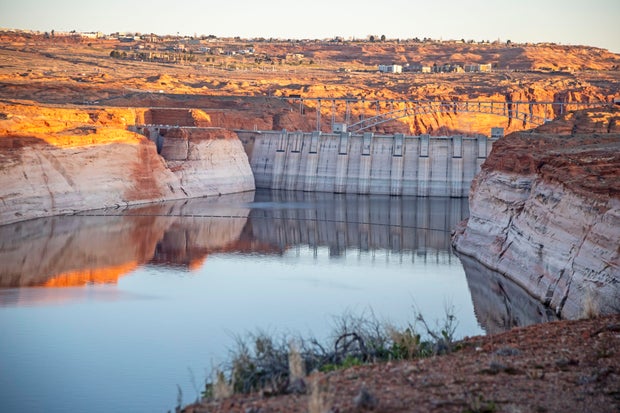
Record-low snowpack across Colorado, Utah, New Mexico and Arizona threatens the West’s primary water source (snow accounts for roughly 75% of regional supply) and imperils the Colorado River Basin that supports ~40 million people. Lake Powell is about 25% full and federal forecasts indicate levels could drop below hydropower turbine-operating thresholds by year-end; many California/Nevada locations face <50% of normal spring/summer supplies and some Nevada reservoirs could fall to ~9% of normal. Reduced snowmelt also raises the risk of an earlier, potentially more severe wildfire season and accelerates stress on irrigation and rural water-dependent economies.
Supply-side winners are the companies that enable rapid adaptation: municipal water-equipment providers, pipeline/upgrade contractors and grid storage OEMs should see a near-term lift in urgent retrofit and emergency procurement budgets as operators prioritize resilience over multiyear planning cycles. On the demand side, marginal energy suppliers that can flex capacity into summer peaks (natural‑gas producers and peaker operators) will capture higher spark spreads as thermal generation fills any shortfall from seasonal hydroflexibility; this also amplifies summer price volatility in regional power markets. Insurance and reinsurance markets face a bifurcation: loss-impacted balance sheets could underwrite higher premiums and tighter capacity next renewals, yet very large near-term claims would be the main downside shock to insurers with concentrated regional exposure. Agricultural commodity processors and exporters with water‑intensive footprints are second‑order losers—crop mix and acreage reductions will compress volumes and margin, but could push grain prices and input volatility upward, creating both margin pressure and hedging demand for processors.
Tail risks that would flip these dynamics are short and sharp: a strong storm/climate teleconnection event could restore seasonal water buffers within weeks and materially compress implied forward price moves in gas, power and water‑capex equities. Medium-term catalysts include federal emergency allocations, interstate water transfers, and accelerated state rate cases that shift costs to ratepayers; each would change who carries the economic burden and the timing of cash flows. Over years, structural policy (large infrastructure bills, desalination expansion, groundwater banking reforms) will reprice winners permanently; over months, insurance renewals and summer power dispatch economics will determine P&L outcomes. The most dangerous tail is simultaneous large claims plus liquidity stress at regional utilities or irrigation districts, which could widen muni credit spreads.
The consensus focuses on immediate scarcity; it underappreciates operational levers water managers hold (temporary transfers, groundwater pumping, managed releases) and the speed at which utilities can re‑optimize generation stacks and procure short‑term capacity. That argues for hedged, time‑limited positions rather than long–only sector bets: capture convexity to summer price moves with options and favor names that sell interoperability and recurring services (maintenance, monitoring) over pure equipment suppliers with long manufacturing lead times. Position sizing should assume a non‑zero probability of rapid hydrologic recovery within a 60–90 day window, so prefer defined‑risk option structures or paired trades that monetize basis differentials rather than naked directional exposure.
AI-powered research, real-time alerts, and portfolio analytics for institutional investors.
Request DemoOverall Sentiment
moderately negative
Sentiment Score
-0.55
