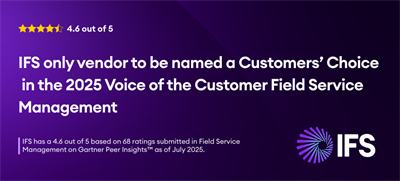
IFS was named the sole Customers’ Choice in Gartner’s 2025 Peer Insights Voice of the Customer: Field Service Management report, a distinction the company cites as independent validation of its Industrial AI-led Field Service Management capabilities. The recognition, together with prior Gartner placements (Leader in Cloud ERP for Product-Centric Enterprises and Customers’ Choice in Manufacturing), underscores strong customer satisfaction and product positioning in service management—factors that can support future service revenue growth but are unlikely to move markets materially absent accompanying financial results or guidance.
Market structure: IFS’s Gartner Customers’ Choice distinction meaningfully raises competitive pressure in Industrial AI-enabled Field Service Management (FSM) but has limited immediate direct market-share impact because IFS is private. Public SaaS/ERP leaders (ServiceNow NOW, Salesforce CRM, Microsoft MSFT, SAP SAP, Oracle ORCL) face increased buyer bargaining toward composable, AI-first FSM — winners will be vendors that can show 3–7% incremental ARR growth from service upsells over 12–24 months; losers are legacy on‑prem players and small niche FSM vendors without AI roadmaps.
Risk assessment: Tail risks include AI-regulation (data/ML transparency) and a manufacturing capex pullback; a 15%+ cut in industrial capex could translate to a 10–20% hit to FSM license growth for 2–4 quarters. Immediate effect is PR-driven sentiment (days); short-term (weeks–months) is pipeline acceleration/contract announcements; long-term (quarters–years) is market-share and margin reallocation. Hidden dependencies: cloud provider costs (AWS/Azure), talent scarcity for ML implementations, and customer integration risk.
Trade implications: Prefer selective exposure to public software leaders that can industrialize AI for FSM — tactical 3–6 month option structures to capture re-rating on product announcements and enterprise deals; industrials with large service books (ABB) are secondary beneficiaries via higher recurring revenue and service margins. Hedge implementation risk with short exposure to small-cap or on‑prem ERP names showing >200bp margin deterioration; use relative-value pair trades to isolate FSM adoption upside.
Contrarian angles: The market may understate that IFS is private — public peers already price AI expectations, so positive reaction could be muted. Conversely, industrial hardware/service names (ABB) may be underappreciated beneficiaries — a missed consensus re-rate there could deliver 15–25% upside over 12 months. Unintended consequence: faster feature parity could commoditize FSM licensing, pressuring long-term ASPs and forcing vendors into services-led revenue mixes.
AI-powered research, real-time alerts, and portfolio analytics for institutional investors.
Request DemoOverall Sentiment
moderately positive
Sentiment Score
0.50
Ticker Sentiment
