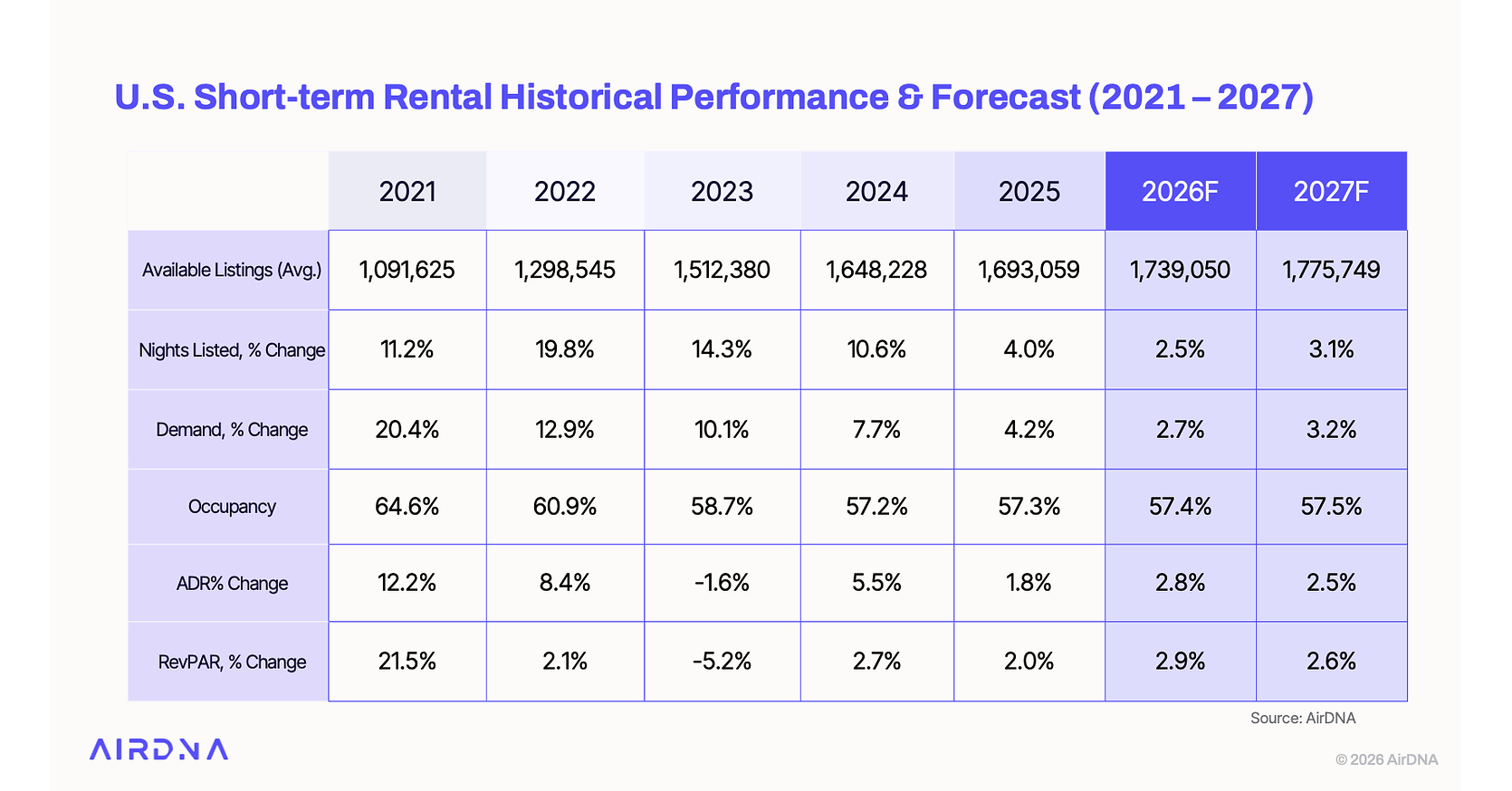
AirDNA says mortgage rates have moved back above 6% as renewed inflation—linked to the Iran war and an energy shock—delayed new short-term rental supply, slowing investment. At the same time, healthy travel demand is supporting occupancy and stronger pricing, with RevPAR up in select tight-supply markets (San Francisco +12.1%, Anaheim +11.0%, Philadelphia +10.1%) and international STR demand running 12% below last spring (Canada down 32%). As inflation eases, AirDNA expects demand and investment to strengthen in 2027, with shifting travel behavior (shorter trips, shrinking lead times) and the FIFA World Cup boosting host-market pricing.
The real signal here is not travel demand; it is supply elasticity. Higher financing costs are acting like an invisible capacity cap, which is bullish for incumbents with existing inventory and for platforms that monetize booked nights without funding the asset base. The second-order loser is the marginal host/investor who was counting on leverage to expand; that delay can preserve ADR and occupancy for 2-4 quarters, but it also means the industry remains more cyclical than the headline demand data suggests.
The mix shift toward larger, group-friendly accommodations favors the broad-based marketplace model over narrower urban-business travel exposure. That should matter more for the next 1-3 months than for the next 12-18 months, because event-driven demand and domestic leisure can offset weaker international inbound, but they do not change the underlying economics of new supply. If mortgage rates roll over materially, this becomes a 2027 story rather than a 2025 story, and the pricing power we are seeing now should normalize faster than consensus expects.
The contrarian read is that the market may be over-weighting demand and under-weighting the eventual supply response. The strongest growth in smaller, cheaper markets is usually the first sign of a delayed competition wave; once financing eases, those markets can flood quickly and compress returns faster than coastal, high-barrier cities. That makes this more of a relative-value setup than a broad sector call, and it argues for owning operators with direct market data and disciplined yield management rather than betting on the category beta.
AI-powered research, real-time alerts, and portfolio analytics for institutional investors.
Request DemoOverall Sentiment
neutral
Sentiment Score
-0.05
Ticker Sentiment
