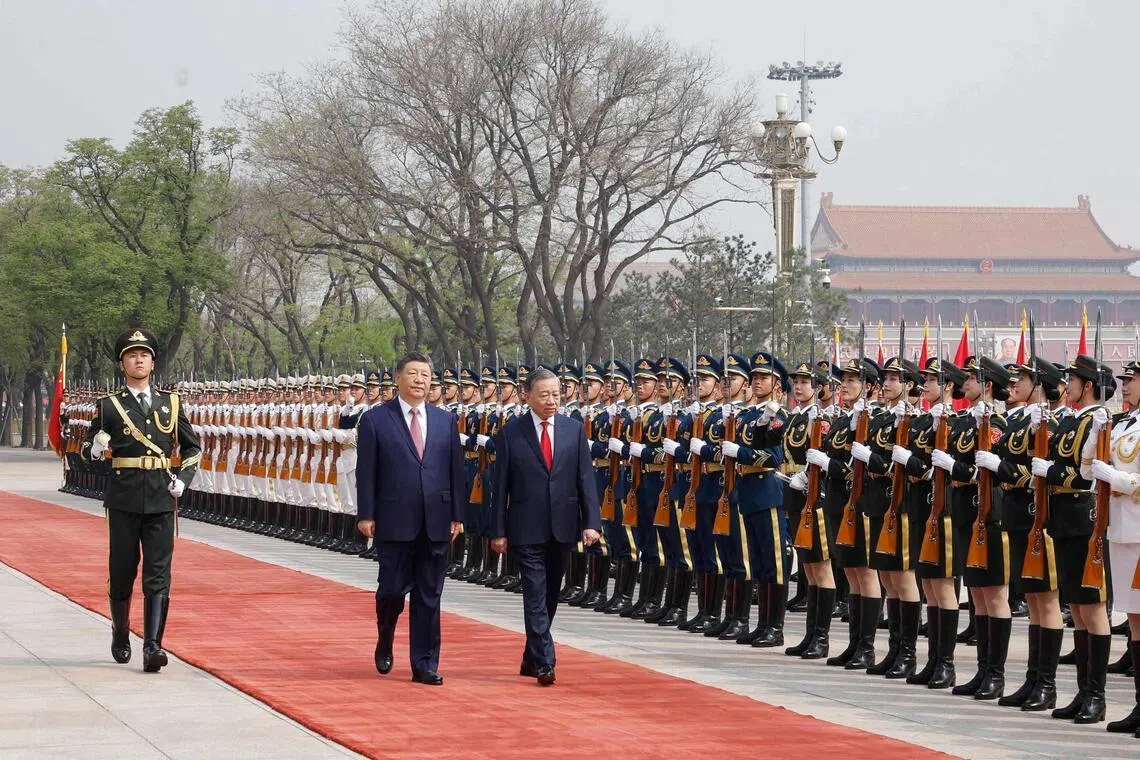
A week of high-level diplomacy in Beijing underscored China’s role as a perceived “power of certainty” amid Middle East conflict and energy-supply disruptions. Xi Jinping met leaders from Spain, the UAE, Russia and Vietnam, offering a Middle East peace proposal, affirming Russia energy ties, and reinforcing Vietnam relations; Russia said it is ready to raise energy supplies to China. China also reported Q1 2026 GDP growth of 5.0%, above the 4.8% consensus and up from 4.5% in Q4 2025, supporting Beijing’s stability narrative.
The market implication is not “China is rising” so much as “China is becoming the default coordination venue when volatility spikes.” That matters for energy-sensitive EMs: if Gulf and Asian counterparties increasingly hedge through Beijing, China’s policy stance starts to function like an informal shock absorber for trade flows, shipping lanes, and commodity procurement. The second-order winner is China-linked logistics, insurers, and commodity intermediaries with pricing power in rerouted supply chains; the loser is any middleman dependent on US-centered diplomatic clearance or Gulf-centric transit certainty.
The more tradable signal is on energy dispersion, not outright oil direction. A Middle East flare-up that is partially offset by China-Russia energy cooperation can keep Brent elevated while compressing time-spread volatility and widening regional differentials, which tends to favor traders in physical arbitrage, LNG, and tanker utilization over pure upstream beta. If Beijing is perceived as the “stable” counterparty, capital may rotate toward China-facing industrials and EM credit, but that is fragile: the move reverses quickly if China’s growth or policy credibility disappoints, or if Washington reclaims diplomatic initiative and normalizes route security within weeks.
Consensus is likely underpricing the political economy of Vietnam and ASEAN. A balancing strategy that deepens dependence on China’s industrial inputs while preserving US security links creates hidden vulnerability in supply chains for electronics, machinery, and semicap equipment: firms with China-plus-one production concentrated in Vietnam may see short-term resilience but higher policy noise and tariff optionality over the next 3-12 months. The contrarian read is that “certainty” may be cyclical and overstated; if China is being used as a hedge against US unpredictability, any moderation in US rhetoric or de-escalation in the Middle East can unwind this premium faster than fundamentals justify.
AI-powered research, real-time alerts, and portfolio analytics for institutional investors.
Request TrialOverall Sentiment
neutral
Sentiment Score
0.05
