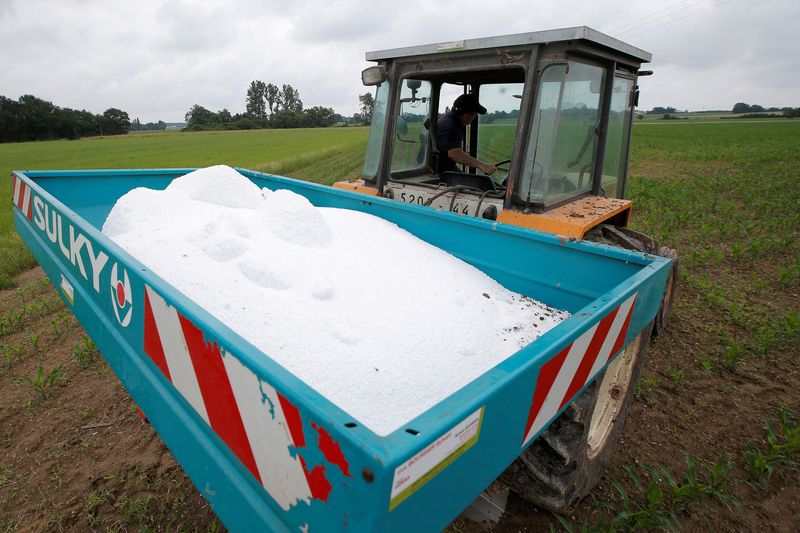
Urea prices have surged more than 50% as Middle East conflict and disruption around the Strait of Hormuz tighten nitrogen fertilizer supply. Capital Economics warns the shock could lift global food inflation for the next 15 months, with U.K. food inflation potentially rising above 6% by 2027 and the U.S./eurozone peaking near 4%. The macro GDP hit should be limited in developed markets, but lower-income economies in Sub-Saharan Africa and South Asia face a materially higher risk of crop-yield pressure and economic drag.
The main equity implication is not a broad “food inflation” trade but a dispersion trade across the ag complex and the consumer basket. Higher urea prices improve pricing power for nitrogen producers outside the disrupted corridor, while squeezing low-asset-turnover farmers first; the second-order winner is fertilizer logistics, storage, and distributors with inventories sourced before the spike. The real P&L hit shows up later: if input costs stay elevated into the next planting cycle, downstream exposure migrates from ag names into food processors, restaurant chains, and EM consumer staples with weak pricing power.
The timing matters more than the headline. Because the shock feeds through with a 9-15 month lag, front-end inflation prints may stay benign while forward inflation expectations drift higher, which is toxic for duration-sensitive sectors even before actual food CPI accelerates. That creates a window where consensus can underprice the eventual margin squeeze in low-income EMs, but also overestimate the urgency for developed-market central banks, limiting immediate policy response. In other words, the trade is more about 2026-27 earnings revisions than about next month’s macro data.
The least appreciated risk is substitution and conservation. Farmers can partially offset nitrogen costs by reducing application rates or switching crop mix, which caps the long-run shock but lowers yields and raises volatility in staple prices; that means the macro damage may come in waves rather than one clean spike. If shipping normalizes faster than production capacity, fertilizer prices can retrace sharply before the inflation pass-through fully lands, creating a dangerous mismatch for anyone long the inflation narrative too early.
For portfolios, the cleanest expression is long upstream fertilizer quality and short downstream margin vulnerability, with an emphasis on names that can self-supply gas or have low-cost regional feedstock. EM sovereign and consumer credit risk should be monitored as a lagged macro short, not an immediate panic trade. The opportunity is in the delayed second derivative: buy assets that benefit from sustained input tightness and fade sectors whose earnings are most exposed to eventual food-cost pass-through.
AI-powered research, real-time alerts, and portfolio analytics for institutional investors.
Request DemoOverall Sentiment
strongly negative
Sentiment Score
-0.55
